Skip to content

SCOTT LYERLY

  • Home
  • About
    • Contact
    • Bio
    • My Tourette Syndrome Story
  • Books
    • The Last Line
    • Anthologies
  • Other Writing
    • Short Fiction & Essays
    • Blog
  • Upcoming Events
  • Etcetera
    • Newsletter Sign-up
    • Privacy Policy
  • Facebook
  • Instagram
  • Threads
  • TikTok
  • Bluesky
  • The Maffetone Method – A Comprehensive 6 Month Review Of My Training

    April 2nd, 2014

    With the end of March, I finished my first six months of using the Maffetone Method as a training program for running. For those of you unfamiliar with the Maffetone Method, you can find more information on Phil Maffetone’s website.

    What led me to begin the Maffetone Method? It was two distinct things, really. I talked about both in a previous post, but to recap: I was fighting of a potential foot injury, and I stumbled upon one of Phil Maffetone’s books in the chiropractor’s office.

    So began one of the more interesting experiments I’ve done for myself in a long long while.

    Like all experiments, I knew I would need data for this one. So I created an Excel workbook. If you haven’t read other parts of this blog, then you don’t know that I’m a pretty sizable Excel geek. I created a workbook and started tracking the data I had available, namely, the date of each run, the number of miles, the pace per mile, the number of calories burned, the average heart rate, and the maximum heart rate.

    All of this went into the Excel file, and then I started playing with it, creating statistical formulas with it, and graphing it. The first thing I did was to come up with the average pace per run. Easy enough. It’s just the average pace of all the laps in each individual run. The next thing was to throw out the highest and lowest average pace. My reasoning for this was two-fold: I knew eventually I would start racing (which I did back in January) and so, if I had one race per month (which I knew I wouldn’t, but just in case) then this adjusted average would throw the race pace out. Conversely, anybody can have a crappy training run (I’ve had several, such as this one) and an off day shouldn’t negatively affect your overall numbers. So the high and low pace went. That left the adjusted average pace for the month, and this would become the basis for measuring improvement.

    But there’s a whole other piece to the Maffetone Method, and that involves heart rate. In order for the method to work, you’ve got to keep your heart rate at a specific target. Maffetone’s very basic formula is 180 – current age = target heart rate. As you get older, as I am, that drops the target WAY down. Running slow takes some getting used to, although after six months, it’s pretty easy to find a rhythm. But to do this, you need to strap on a heart rate monitor while you run. And this leads to the second major data point I needed to track: heart rate.

    Heart rate is a tricky one, I found. I live in the Northeast, where there are hills and hills and more frickin hills. Going up the hill while trying to run at a slow pace means you usually have to drop down to a walk, which I loathe. Even then, the heart rate is going to go up and down. So I’m largely tracking to average heart rate, which is the measure of what your heart did the entire time you were running. Again, I’m throwing out the highest and lowest average for the same reasons I did so with pace: racing and crappy runs.

    All this was a nice set up, except for two problems.

    The first was a bad heart rate monitor. It was fine for a while, but then it started to do all kinds of weird things, like jump up to 179, then drop to 75, then stabilize around 142. This caused more than a few whiskey tango foxtrot moments for me. In addition to the jumps and drops, it was just not as responsive visually as I needed. Maybe it was recording the data correctly and in real time, but when it would go down as I went up a hill, only to go up at the very end and keep going up as I started down a hill made me realize it was probably shot. (Yes, before you ask, I tried replacing the batteries.) So at the end of March I got a new one (which I like a lot, but that’s for another post).

    The second was that I cheated. Not really on purpose, and with the best intentions. I wanted to capture ALL the calories I was burning during a workout, which meant turning on the heart rate monitor even during the warmups and letting it ride during the cool downs. Thus, I was capturing calories burnt better, but I was also influencing the average heart rate by allowing the lower heart rates during warmup and cool down to lower the average. I did this during the first few Maffetone runs in September and all the ones in October, then I stopped. From November on, the heart rate data is cleaner than it was before, which might not be saying much given the quirkiness of the monitor.

    Okay, so that’s enough background. What does the data tell me about the last six months? Well let’s take a look at the artwork (note: this is more or less the same artwork I posted in my update on my sixth month running, but today we’ll be focused on a few different things):

    running_stats_6month_review

    maffetone_avg_month6

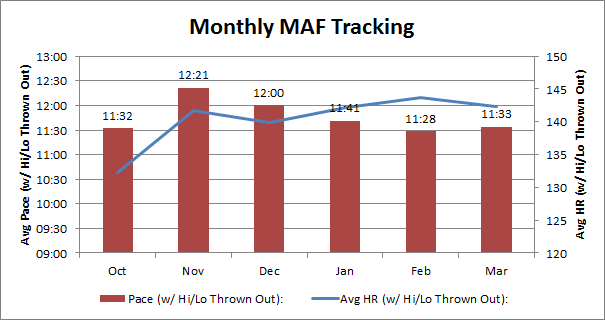
    The first thing I looked for was improvement. In its simplest terms, am I running faster now than I was six months ago? At first glance the answer appears to be No, I am not. In fact, I lost a few seconds overall in the adjusted average pace. But that’s compared to October. October seems to be an outlier of sorts. What you don’t see in here are the three runs I did at the end of September when I first started following the Maffetone Method. September’s adjust average pace is a good 45 seconds higher than October. And after October, my pace shot back up into the 12 minute range and has been coming down slowly since. (Not for nothing, but this slow improvement is the kind of improvement I would have expected from the Maffetone Method, and not wild swings.)

    What’s the story with October? I can’t speak in absolute certainty, but I’m will to hazard a guess. I think it comes back to the “cheating” I explained above. Knowing that a walking warmup and walking cool down would lower my average heart rate, I think I, consciously or unconsciously, allowed my heart rate run higher during the main body of the run. This would naturally lead to a faster pace, as I could go longer with an elevated heart rate and let the cool down bring the average heart rate down. I say “consciously or unconsciously” because I don’t have a specific recollection of thinking of this strategy through and then executing it, but that was six months ago. So it’s possible. And September? With only three runs in that month and a new method to adjust to, the high pace was largely a matter of “getting used to it”.

    In tandem with pace, I looked at my average heart rate. As with pace, this represents a number with the high and low thrown out. What did I see when I reviewed it? I found my heart rate was slowly going up. Not a lot. The highest average heart rate we see above is in February at 144. The lowest, excluding October, is 140. In addition, we seem to have a correlation between the rising heart rate and the falling pace. This one alarmed me. Because if my pace was dropping only because my heart rate was climbing, it means that I’m not really making much progress, only running a little faster without having improved my aerobic capability. Which could lead me to conclude that the method failed.

    This is not what I wanted to hear.

    It turns out that March, despite what a crappy running month it was (see above that I only got outside six times), my heart rate dropped back down to 142, as it was in January, and my pace between January’s adjusted average and March’s adjusted average dropped 9 seconds, from 11:41 to 11:33. This restored some hope I had that I might actually be improving.

    So, assuming I am improving and not just running faster while elevating my heart rate, and if we throw out the skewed data from October, we can see that I improved by 48 seconds, from November’s average pace of 12:21 to March’s pace of 11:33. Over a five month time period, that’s a 9.6 second improvement per month.

    But does that mean anything? Let’s put it in some perspective.

    If I keep up this slow-run method of training, gaining (for the sake of argument, let’s round down) 9 seconds average per month, then in another two and a half years, the equivalent of thirty more months, I could knock 270 seconds off my average pace. That’s a 4 1/2 minute decrease. That would bring my pace down to 7:03 per mile. With a heart rate remaining in the 142 range. That’s frickin enormous!

    Now, let’s add some reality to this. I’m not likely to decrease my pace by 9 seconds every month. There will be off months, there will be setbacks, there will be plateaus. I’m fighting with my foot again, which could be hugely problematic later in those two and a half years. In other words, shit happens. But let’s say that, on average, my pace only decrease by 5 seconds per month. That’s 150 second improvement, or 2 1/2 minutes, which would bring my pace down to 9:03 per mile while keeping my heart rate in that target zone. This is big stuff.

    That’s my overall data analysis. But I’m not quite done here yet.

    Let me take a step back for a moment from all of this data. I think I’ve sprained my math ligament anyway. I need to hobble to a chair to sit down. What I haven’t done yet is talk in the broad sense of how I feel. I’ll cover that now in two areas: injury and fuel.

    The first is injury. How this whole Maffetone Method business got started was that I was developing a pain in my heel and went to the chiropractor to seek help, where I discovered Maffetone’s older book on endurance training. Truth be told though, it wasn’t just my heel, it was also one of my knees getting sore and a tugging going down my hip. The heel was just the biggest problem in the way.

    I received treatment in the form of chiropractic care, and my legs and feet started to feel better. I also bought a new pair of shoes that are more minimalist running shoes than I had before. I bought those in early December. Here we are four months later. How do I feel?

    The answer is qualified. I feel mostly pretty good. For the first three months or so, my foot felt fine. Only now, within the last few weeks, have I begun to feel the dreaded pain in the bottom of my foot. It could be that I need new shoes again. It’s been four months and about 150 miles on them. It might be time to replace them. I’m not ready to make that call just yet, I’m hoping to get more out of the ones I have, but I might not be able to do it. Especially now that winter appears to be over. With the arrival of Spring and the increase in light, I know I’ll want to go out, if not more often, than at least longer when I do go out.

    But the rest of my body feels fine. My legs are good, my knees are not sore, I don’t feel any tugging anywhere. So for the injury side of things, slow running has helped keep me running while keeping me from being injured.

    The second item is fuel. What I mean by that is how often I’ve “bonked” when running. When I was running last summer, I would always have at least a gel for a 6 or 7 miler along with a small running bottle filled with vitamin water. For longer runs I’d take a full set of the Clif Blocks.

    I’ve run up to eight miles twice since using the Maffetone Method, with the average runs increasing to where I’m doing 5 miles for a regular run.

    I have not “bonked” once. Not even shaky. For me, this is one of the most telling things about the Maffetone Method. Since I’m not “bonking”, I don’t appear to be relying on whatever glucose I have in my system. I should therefore be burning fat for fuel. (If only I were eating better, I might be losing the winter weight faster…)

    So that’s where I am after six months. I’ll keep posting a month by month review of the immediately preceding month, and at the end of September, expect to see my running year in review.


  • The Maffetone Method – 6 Months In

    March 31st, 2014

    We have arrived at the end of another month. Another month of Maffetone endurance training has passed us by. Well, maybe it’s safer to say that another month has passed us by. Cause the training part was pretty sparse.

    The end of March marks the six month of my using the Maffetone method as a training routine to try and improve my endurance and run faster. This doesn’t mean running faster during the training runs, but running faster in races. Since I’ve only done one official race, it will take at least one more for me to get any decent understanding of how this method has been working.

    But let’s not get ahead of ourselves! I’ll post a review of the past six months shortly, but for now, let’s focus on March. Which, weather-wise, sucked.

    March came in less like a lion and more like a pride of them. It’s going out like a single lion, which I suppose is an improvement. But a lion is still a lion, and when I got in my car this morning, it was sleeting. That changed to snow for a brief period, at which time I thought I might literally have an aneurism. I am so. Sick. Of. Winter. And it showed this March.

    I ended February pretty weak, with only two runs in last fourteen days of that month. March started of worse, since I went fifteen days between runs. I ran on March 1st, and then not again until March 16th.  I hit the wall. I couldn’t stand the idea of running in the cold and dark any more. I had a hard time even getting out of bed on time. It was the tail end of a long winter, and the tail was barbed.

    I finally did get myself up and out, and since that March 16th run, I managed to get myself out the door four more times. A measly six runs in a thirty-one day period. Not too great. Especially for a guy who has delusions of running a half-marathon in June. Yeah. That’s two-and-a-half months away. I might be screwed.

    Except…

    I caught a little glimmer of hope on my last run. It was on March 28th, after work. Daylight Savings Time is back on, and it’s light now until nearly 7PM. That last run, it was a little rainy, more misty than anything else. But it was 51 degrees. It was the first time I had the chance to run in short and just a few shirts. It was the first time all winter that I could run without having to gear up in fifty pounds of winter protection. It made such a huge difference and was enough to make me remember how much I enjoy running.

    (Ask me again how much I enjoy it in the dead of August when it’s 95 degrees.)

    So, with all that said, how’d the month stack up statistically? Let’s take a look:

    maffetone_avg_month6

    running month 6

    Overall, my average pace with the high and low paces thrown out went up about 5 seconds. Given how little I ran, I think that’s actually pretty good. I also have a new heart rate monitor now that is much more reliable that the one I had been using, so the heart rate data will start to be better to review in the coming months.

    Overall, March wasn’t stellar. But April brings new promises, and as the weather gets nicer, I’m hoping my training improves.

    That’s it for now. I’ll post a six month review in the next day or two.

  • How Was Your Weekend/Review of “The Peacemakers”

    March 30th, 2014

    Peacemakers Cover

    Let me do two things at once. Let me describe my weekend using a review as a medium. Sound like a plan? Cool.

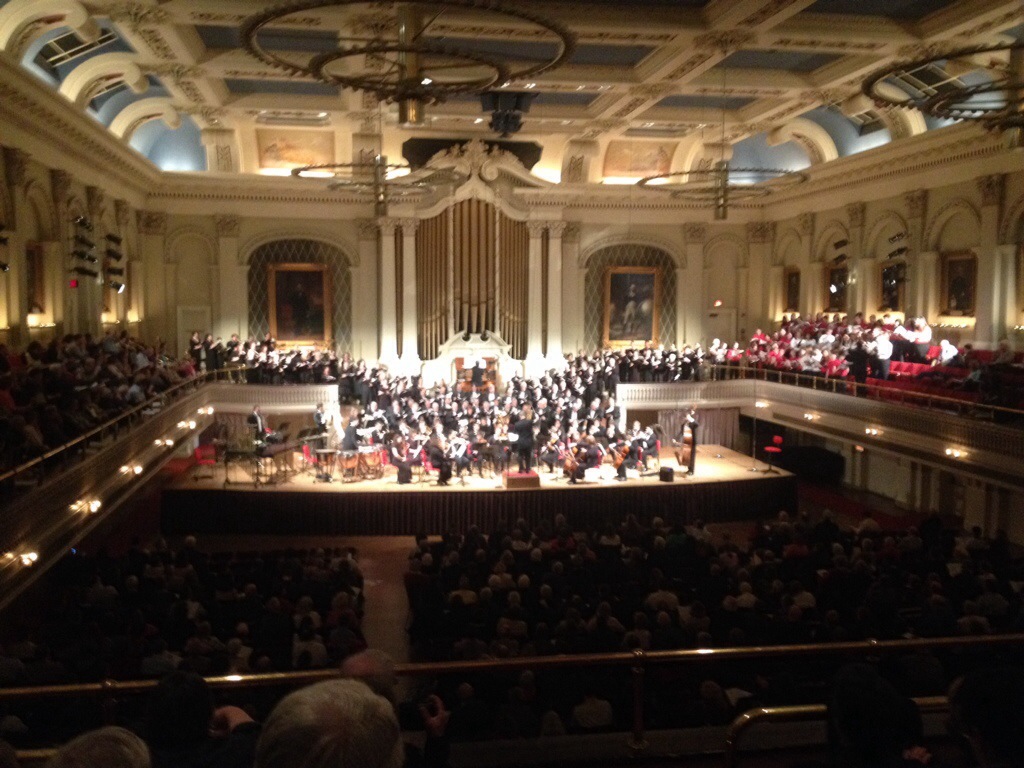
    This weekend was the Massachusetts premiere of a piece of music called “The Peacemakers“. Written by Karl Jenkins, it was originally performed in Cargenie Hall, it was performed in Mechanics Hall in Worcester, MA today by the Master Singers of Worcester.

    I was fortunate enough to see this piece today with the kids. But that was not unexpected, as my wife was a member of the chorus.

    This was a big piece of music. There are seventeen different movements, but each movement isn’t as long as you might traditionally think of movements in a symphony. Nothing that long. And with the exception of one of movement, every one of them had a choral component.

    The Master Singers put this piece on, but they where joined by a number of other churches that lent choir members to the chorus, which beefed it up to over a hundred adults. Add to that the Worcester Children’s Chorus, and an orchestra provided by the WPI Orchestra, and you get a very large sound. Then top it all off with the Hook Organ, sometimes know as the “Worcester Organ”, which is the large and locally famous organ resident in Mechanics Hall.

    So how was it? Pretty damn impressive.

    The overall work had a more somber feeling to it than I was anticipating. But with some of the text attributed to historical figures such as Anne Frank and others who used peace as a means for change and who were assassinated or martyred as a result, you shouldn’t expect a happy-go-lucky vibe. But that doesn’t stop it from being big and beautiful and impressive, with all of the pieces meshing together pretty seamlessly.

    As for the performance, it was as excellent as the hall would allow. That sounds pretty qualified, doesn’t it? Yeah, maybe it is, but only a very very tiny little amount. We were sitting in the center balcony section, left hand side. Maybe this isn’t the case in other parts of the Great Hall, and since I haven’t seen something there well over a decade, but up there the sound gets eaten by the acoustics. For example, the solo singers (there were two) were beautiful but a little hard to hear, with their voices being swallowed by the audience and the nearly two hundred people on the stage. And when the full chorus was in swing, you might have been asking yourself “Strings? What strings?”

    The night would not have been complete without the organ making it’s presence know by sticking open for an extra second after the end of once of the movements. But it’s 150 years old this year. What do you expect, perfection? I hope I’m around and as feisty when I’m 150 years old.

    All of these, though, were little quirks in an otherwise gorgeous piece of music. If you get the chance, I highly recommend seeing a quality group perform this, as it is a once-in-a-lifetime opportunity.

    20140330-204738.jpg

  • Flying Tigers

    March 25th, 2014

    20140320-213231.jpg

    This is going to be one of those sappy-daddy-loves-his-daughters kind of posts. If that’s not your cuppa, exit now.

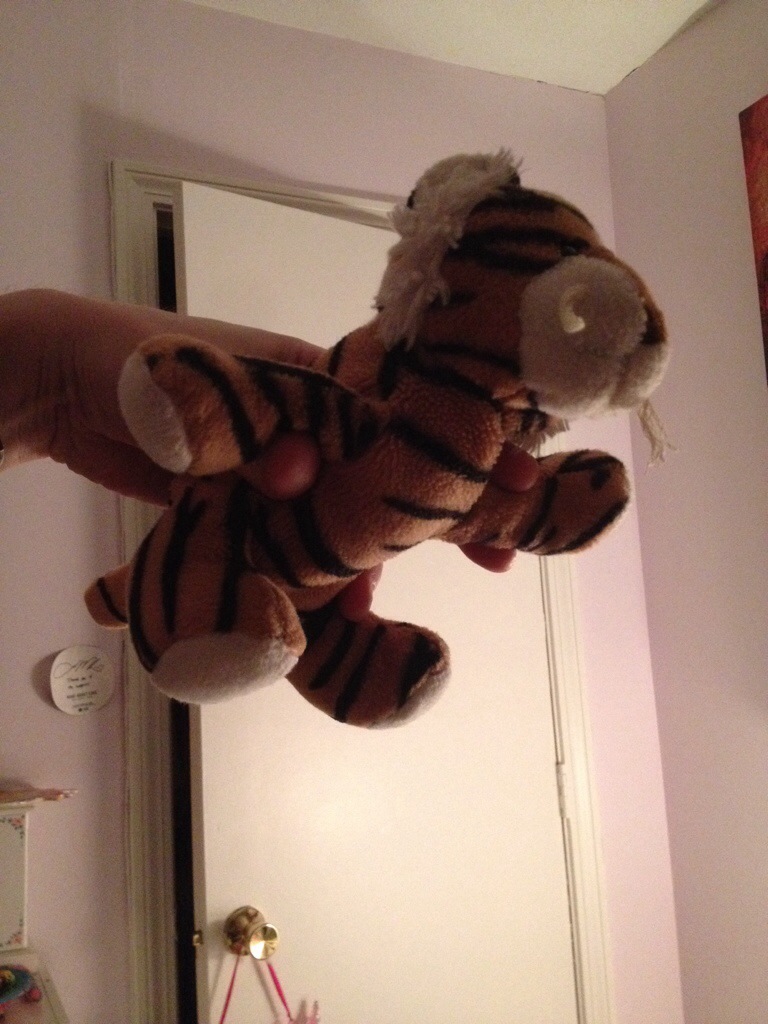
    Still there? Well then, meet Joshua. This is the name of the stuffed tiger you see in the picture above. My older daughter named him.

    Now, technically, he’s mine. He was a gift from said daughter back on a birthday or Father’s Day a bunch of years ago. But, given how much Joshua seemed to prefer my daughter’s company to mine, I let him hang out in my daughter’s room.

    You might be wondering why I’m posting about a stuffed tiger? Hey, if Miline can write about a stuffed bear named Edward, why can’t I write about a stuffed tiger named Joshua?

    The main reason I’m thinking about Joshua these days is because, out of nowhere, he has returned. When my daughter was younger, in the five to six range, I would tuck her into bed, and then Joshua would join the party. He was a happy addition with a special quality: he could fly.

    When Joshua’s arms are outstretched, he looks like he might take off into the air. And one day, as it happens, he did. I used to fly Joshua around my daughter’s bedroom before bed and she would spend time trying to catch him in her hands.

    Fast forward a number of years. Unannounced one day a week or two ago, Joshua suddenly returned to the stuffed menagerie that occupies my daughter’s bed every night. I picked him up one night and, for nostalgia’s sake, flew him around the room. And my daughter, remembering how the tiger used to bring the fun, decided to try and catch him.

    We’ve been doing this now for about a week. And it’s like a connection to a past you forgot you used to love. My daughter turns back into a five year old when Joshua flies around her room, in the same way I turn into an eight year old when I get hold of a box of Legos.

    I know it won’t last. There’ll finally be that night where one, the other, or both of us decide we don’t need to fly the tiger. But until then, I’m holding onto these moments with both hands.

    20140325-205831.jpg

  • Excel Geeking: Sending A Selection To OneNote With VBA

    March 21st, 2014

    It’s been a little while since I’ve geeked out with some VBA that would be anything worth posting, which means that the routine I wrote today was just that much sweeter.

    I recently discovered Microsoft OneNote. We have it and at work and it is the singularly best kept secret we have. If you have the chance to use this little gem, I recommend it.

    I won’t get all gushy about OneNote here, but you can look it up online. In a nutshell, it is a singular place to keep track of all kinds of things, like notes (duh), to do lists, snippets of things from the web, documents from Word, etc. You can hit Record in a meeting and it will record and save an audio file of the conversation, which you can listen to later to assemble your meeting minutes. You can share notebooks with people across the network or the web–the point is that it’s a great application. It’s a lot like Evernote, if Evernote were fully integrated with MS Office. And OneNote has a great mobile app so you can access your notebooks from your iPhone or iPad.

    Okay, sorry, enough gushing.

    What I really wanted was some method for sending pieces of Excel worksheets to OneNote without a lot of headache. Some method for sending a selection of the worksheet to OneNote with a single command or keystroke. Yes, I know I can highlight the selection, go to File, go to Print, change the settings to Print Selection only, change the printer to OneNote, then click print. That’s a lot of mouse clicks. Five in total, with more if you want to revert back to your normal printer.

    Can’t I just use a button or keystroke to send something to OneNote without all the hullabaloo?

    I can now.

    The routine below is basically nothing more than the automation of all the mouse clicks I mention above. Except they’re tied into a keystroke I’ve created upon opening the workbook. So now, to send something to OneNote, All I need to do is hit Ctrl+Shift+N.

    The main routine is below.


    Sub PushExcelContentToOneNote()
    '*******************************************************************************
    ' Description:  This will take the selected content and print it to OneNote, then
    '               reset the printer back to the original printer prior to the routine.
    '
    ' Author:       Scott Lyerly
    ' Contact:      scott.c.lyerly@gmail.com
    '
    ' Name:                             Date:           Init:   Modification:
    ' PushExcelContentToOneNote V1      21-MAR-2014     SCL     Original development
    '
    ' Arguments:    None
    '
    ' Returns:      None
    '*******************************************************************************
    On Error GoTo ErrHandler

    ‘ Constant declaratios.
    Const sONENOTE_PRINTER      As String = “Send To OneNote 2010 on nul:”

    ‘ Variable declarations.
    Dim sOriginalPrinter        As String

    ‘ Get the original printer first.
    sOriginalPrinter = Application.ActivePrinter

    ‘ Make sure One Note is the active printer.
    Application.ActivePrinter = sONENOTE_PRINTER

    ‘ Print to OneNote
    Selection.PrintOut Copies:=1, Collate:=True, IgnorePrintAreas:=False

    ‘ Reset the original printer.
    Application.ActivePrinter = sOriginalPrinter

    Exit_Clean:

    Exit Sub

    ErrHandler:

    ‘ Since the 1004 error number is too broad, we’ll check the error description instead.
    If InStr(Err.Description, “ActivePrinter”) 0 Then
    MsgBox “Excel cannot find the OneNote printer on your machine.” & _
    vbNewLine & vbNewLine & _
    “Operation cancelled.”, _
    vbOKOnly + vbExclamation, “PRINTER ERROR”
    Else
    MsgBox Err.Number & “: ” & Err.Description, vbCritical, “MICROSOFT ERROR”
    End If

    Resume Exit_Clean

    End Sub


    To set the keystroke, add the following in the ThisWorkbook module.

    Private Sub Workbook_BeforeClose(Cancel As Boolean)
    Application.OnKey "^+n", ""
    End Sub


    Private Sub Workbook_Open()
    Application.OnKey "^+n", "PushExcelContentToOneNote"
    End Sub

    Easy-peasy.

  • Online Personalities And Personas

    March 20th, 2014

    Let’s start this one of with an apology. Apologies go out to my wife today. Let me tell you why. This morning my wife started a conversation that caught me by surprise. She says to me, “I read your blog post last night.”

    There was something in her voice that made me pay attention.

    “Okay,” I ventured.

    “I noticed how you listed cooking and cleaning and a bunch of other things that have kept you busy.”

    “That’s true enough.”

    “People are going to think I’m not doing anything around here,” she said.

    I paused for a minute to think about that. “Huh,” I said. I could totally see her point. The way I stated the things that were keeping me busy, it did sound like I was single-handedly running the house. Which is totally not the case. We’ve both been crazy busy, with work, kids, cooking, cleaning, doctor’s appointments, rehearsals, managing homework, and trying to find a little time for each other and for ourselves. It’s a joint effort here.

    But her words made me realize that what gets written online is sometimes misinterpreted, sometimes misunderstood, and sometimes conscious mis-direction. It reminded me of a conversation I had with a friend about a month ago. We were talking about all manner of things (it had been a while since we’d caught up) and one of the topics we landed on was about online personas.

    We ranged over the friends we have in common online; the one still stuck in the past, but whose posts are as honest as the day is long; the one who posts constant updates about everything; the political one; the one who’s always trying to win the internet; the snarky one; the one who can’t quite get the hang of how the whole works (like that esurance commercial); the one who only posts funny pictures; the confessor; the professor. The list goes on and on. There’s a personality out there for each and every type of person posting on social media. Odds are you know someone like the few I mentioned above or are one yourself. (I tend to go back and forth between the one who posts pictures and the snarky one.)

    It’s made me wonder what is the true purpose of social media? Is it to socialize online? Is it to promote yourself in some way, as if your were your only brand? Is it to constantly remind us that just about any meme that features the Dos Equis guy is hilarious?

    I started to think down the road of self-promotion. About how people brag about themselves online, even if they’re trying not to. There’s even a word for it now: humblebrag.

    I don’t think it’s a big secret that people brag about themselves online. We all do it. Hell, one of the reasons I started blogging in earnest was to be able to promote my self-published fiction. And the big question that seems to be getting asked now is, how much is too much? There are all kinds of article on the topic. Want some? Here are a smattering:
    http://www.upstart.net.au/2013/10/30/self-promotion-through-social-media/
    http://news.cnet.com/8301-1023_3-57583450-93/social-media-self-promotion-the-urge-the-ick-the-outcome/
    http://socialmediatoday.com/curtis-harrison/1596496/it-s-social-media-not-me-media
    http://adage.com/article/small-agency-diary/social-media-s-potential-drowning-promotion/233776/

    I remember hearing a story about one media reporter saying her friends would tell “your life seems so great!” to which she replied, “that’s because you only see the good stuff, cause that’s all I post.”

    I was preparing an argument as to why this phenomenon is bad, why people who only present one side of themselves drive me nuts and are probably fooling themselves. It’s not that I want people to air all their dirty laundry in public, but do we really believe that, even in our kvetching, we’re all having a grand old time?

    But then I stopped to wonder: is self-promotion one of the ways we social with people? And if so, is it so bad a thing? If you’re out for drinks with a friend, the conversation is going to wander through all kinds of avenues. You’re gonna flash back to twenty years ago, you’re gonna brag about something you did or accomplished or that your kids did, you might talk (yell) about politics, you’re gonna talk about the mindless day to day shit. Because all of these things are a part of who we are as humans. We’re social animals and all of these things are things that we do and need to do to keep from losing our marbles.

    The articles above talk about the various reasons why we do it, but mostly it boils down to trying to find a way to stand out in an increasingly loud, visually-overloaded world. Andy Warhol promised us fifteen minutes of fame in the future. Social media seems to be how we’ll get it.

    There are lots of people out there bragging about themselves, building a brand, trying to be seen and get heard. Can’t lie, I’m one of them. I want people to buy my book, I want people to read it, I want people to enjoy it and have conversations with me about it. I guess that means I want to become my own brand. Maybe.

  • Short Short Short (Did I Mention Short) Fiction: Twitter Style

    March 13th, 2014

    A writing festival started this week in NYC. It’s called Twitter Fiction Festival and it’s got a gathering of writers presenting their stories in microburst style. And not shlub writers. We’re talking names like RL Stine and Alexander McCall Smith.

    I love this idea. I think the primary reason I love it is because I get a feeling of completion with every fiction tweet I make. The craft of writing is a tough one and when you’re putting together a large novel with a large cast of characters, multiple sub plots, and moving timelines, you can get quickly swamped by the intricacies and lose the enjoyment of writing. With such short fiction as fits in 140 characters, you craft by way of interference the beginning, middle, and end. Something in there is going to be concrete. The rest is implied and up to the readers mind to fill in with details.

    The other reason I love it is because it fills a creative need at a time when I don’t have a lot of free time right now. I’m prepping part four of How It Ends for release, and editing the crime novel I finished, and there’s always a ton of things to do at home and at work. So the idea of jamming out a “full” story in 140 characters is appealing and refreshing. And tough. After all, with such a short amount of space, you have to make every word, every punctuation mark count.

    I’ve been throwing out 140 character stories for the last two days. I’ve decided to gather them on this blog, under one roof as it were. There’s a new page in the blog starting today which contains all if my Twitter fiction to date. There’ll be periodic updates as I continue to write in 140 character spurts. For now, please enjoy the current crop. Leave some feedback if you’d like, which ones you liked, which you didn’t, what works and what doesn’t and why. I’d love I hear from you.

  • Coffee. Nuf Said

    March 6th, 2014

    Okay, maybe not quite. But I couldn’t think of a better title for this post, so there it is. And let’s be honest, sometimes it is enough. Sometimes the only word that we can get out in the morning is “coffee”.

    But I digress. Shocking, I know.

    There was a article floating around Facebook recently about how the Keurig k-cups might actually be bad for you. I shared it and proceeded to freak out a couple of friends and my wife. The short version: the hot water hits the plastic cups and may cause chemicals in the plastic to bleed into the water that hits the grounds that goes into the mug that goes into your mouth that goes…you get the idea.

    And naturally, when the chemicals in plastic go into your body, badness ensues.

    Whether or not this had any merit of truth to it is irrelevant. The idea is out there and can’t be taken back. Can’t unring the bell.

    So what to do? Well, Keurig, and a couple of other companies no doubt, make an insert that you can substitute for the k-cups. Ostensibly, this is so you can use your own favored brand of coffee that hasn’t put out a k-cup version yet, but let’s be honest, who hasn’t put one out by now?

    Okay, so we bought the insert. Here’s what it looks like:

    20140306-202125.jpg

    It’s basically three pieces: a mesh filter that goes inside another two piece insert that fits into the brewer.

    How well does it work? Pretty well, actually. You fill up the mesh filter with grounds. (I’ll clarify here and say “fresh unused grounds”, which you wouldn’t think I’d need to do, but you never know.) The filter accommodates two levels, one tablespoon or two tablespoons. This obviously goes to your personal preference. Do you like your coffee to resemble coffee, or do you like the stirring spoon to stand up straight in the coffee without you having to hold it? Put the filter in the insert bottom, twist on the insert top, insert the inset into the brewer, and off you go.

    What are the drawbacks? Well, after each brew, you have to take the mesh filter out and clean it. You can’t just chuck it it the trash like you would with the k-cups. It doesn’t take long to do, under a minute, but it’s a little bit of extra time. And you can’t clean it immediate after brewing cause that sucker’s hot. The best bet might be to have two inserts so you can always have one ready to go when the other is done and cooling off before cleaning. This is an especially good idea in households where coffee consumption is measured in gallons. Like mine.

    The other drawback (but maybe not) is that you might have leftover k-cups to deal with. Not a huge deal. You can simply slice open the top and use the grounds inside.

    20140306-203213.jpg

    An interesting discovery in doing this is that the amount of grounds in a k-cup is more than the mesh filter will comfortably hold. So, balancing out the drawback of slicing open your old k-cups is the fact that you’re likely to end up with more brew-able mugs than you would have gotten otherwise.

    Speaking of which, I think it’s time for a mug of decaf.

  • Review: “Fat Chance” by Robert Lustig

    March 5th, 2014

    fat chance

    I came by this book via NPR. I heard the author describing the effects of sugar and heard the title of his book, and decided I needed to know more. That is how I came by one of the scariest books I’ve ever read. Robert Lustig describes sugar as a poison, and by all accounts, including his, he’s right. I’ve been mainlining poison all these years!

    Before we get into the book itself, let’s start with some background. Who is Robert Lustig, and how did this book come to be?

    Right from his profile on the UCSF website, “Robert H. Lustig, M.D. is Professor of Pediatrics in the Division of Endocrinology at University of California, San Francisco, and Director of the Weight Assessment for Teen and Child Health (WATCH) Program at UCSF.”

    So what, you might say. What does that have to do with this book? The answer is actually pretty easy. What Lustig discovered from all his years in medicine is that there is one element that rises above all others as the primary driver of all the metabolic issues and diseases (collectively referred to as “metabolic syndrome”) facing consumers of food (i.e., every human on the planet): sugar.

    Things really got rolling with a YouTube video of Lustig giving a presentation to an audience regarding the dangers of sugar. Entitled “Sugar: The Bitter Truth“, Lustig spends nearly ninety minutes taking the audience through the ins and outs of sugar, focusing on fructose. This is not a lighthearted journey. He goes into the statistics behind what Americans are consuming today versus what they were consuming at the turn of the twentieth century; how glucose, alcohol, and fructose are metabolized in meticulous, borderline mindbogglingly biochemistry detail; and how we got to where we are. First posted to YouTube in 2009, it’s been viewed an whopping 4.4 million times.

    This presentation eventually morphed into the book “Fat Chance“, which was released last year, and which has been released in paperback to coincide with the release of a “Fat Chance Cookbook“. The presentation, and the book as well, are almost story-like in their presentation, at least as much as a medical-laden book and presentation can be. And as any writer will tell you, a good story needs a good villain. For Lustig, that villain is sugar. Fructose to be exact. A villain so diabolical, he refers to it as every evil storybook villain you can think of, from the Darth Vader of food to the Voldemort of food. Or, perhaps more telling, he refers to sugar as a poison.

    Okay, so that’s the background. How about the book itself?

    It’s hard to review a book like this because it operates on a couple of different levels. From a pure readability standpoint, the book often times gets bogged down in its own technical terminology and descriptions. There was more biochemistry in this thing than in Dr. Torrence’s junior year chem class (in which I SCRAPED by with a D). There are so many terms that eventually I stopped trying to remember them all and simply take for granted that someone with a hefty amount of scientific background proofed the book prior to publication.

    As far as narrative voice goes, Lustig’s voice is fairly unique when it isn’t drowning in terminology. He’s a firebrand, preaching from the pulpit of a man who has seen it all and been there. He is not afraid to call out a naked emperor, and it’s not unusual for him to repeat the refrain “We’re screwed”. In one very notable passage, he describes us all as “fructed”. The majority of his chapters open with a brief vignette of a patient case he has dealt with, and more than a few are heartbreaking. There is a force of passion behind his message, one that is not easily ignored nor argued. He is a pediatric endocrinologist, after all, and he knows his shit cold.

    This, then, is where the book really shines. Amidst the preaching of the author, and the technical jargon that will make your head spin, is the long litany of facts, stats, and studies that are at the heart of this book. He makes a point early on saying that every point he makes in the book is based on scientific fact, the sources of which are contained in a notes section at the end of the book. Without these to support his argument, Lustig would likely be seen as an extremist, a fringe-scientist shouting at the masses and not being heard. Because the villain here, again, is sugar, not fat as most diets vilify. And not just the high fructose corn syrup sugar that everyone was up in arms about a few years ago. This is ALL sugar.

    Back in the late seventies/early eighties, the low-fat movement began. Want to control heart disease? Decrease your fat intake and that will help lower you bad cholesterol (LDL). The food industry moved in this direction, lowering the yummy, tasty fat, and ended up with a bunch of bland, boring foods that needed a zing. Enter sugar. At a time when corn crops were subsidized, whether the crop was a boom or a bust, and the price of a newly derived sweetener called high fructose corn syrup sank to incredibly cheap levels, it became easy for the food industry to beef up the flavor using this form of sugar.

    But it didn’t help, did it? No. Because the population has grown more obese. So we instead turned to diets and exercise. Denis Leary laughing described us as gerbils as we continually climbed stairs on the StairMaster. “Where are you going?” “I’m going up!” But even that didn’t help. Why? Because the human body metabolizes different parts of food in different ways. In the heavy biochem part of his YouTube video, Lustig demonstrates that glucose, alcohol, and fructose metabolize differently. And even though he starts off with 120 calories of each, it’s not 120 calories that are absorbed by the body. So you can’t burn 120 calories in exercise and assume that you’ve got a net effect. It just doesn’t work that way. Because (and this is also a constant refrain in the book), “a calorie is not just a calorie.”

    Both the book and the video are eye-opening, and if the book comes off medical-heavy and overly didactic, well that’s really the point. It’s not meant to be a touchy-feely self-help volume about how “You Can Do It If You Just Try Hard Enough”. No, the book argues, you can’t. The odds are stacked against you. The politics of food processing are enormous here, and to make a top-down change is certainly not likely to happen.

    Is it all doom and gloom? Did I spend a week reading a book that scientifically demonstrates the problem but fails to provide a solution. Not at all. While the book spends more time on the problem than the solution, the solution does indeed exist in fiber an exercise. But I won’t go into the details here because you should dive into this book yourself. It’s eye-opening in a way I didn’t think possible. Ever wondered why you feel down after a sugarfest, hungry after a huge sweet and sour infused Chinese meal, or why you Just. Can’t. Escape. Donuts, especially when your stressed? Then this book is for you. You will never look at food, food labels, and ingredient lists the same way again. And trust me, that’s a good thing.

  • Let The Editing Begin!

    March 2nd, 2014

    About five and a half weeks ago I finished the first draft of a hard-boiled detective novel.

    Today, the editing has commenced!

    20140302-084011.jpg

←Previous Page
1 … 31 32 33 34 35 … 42
Next Page→

Create a website or blog at WordPress.com

Loading Comments...

    • Subscribe Subscribed
      • Scott Lyerly
      • Join 200 other subscribers
      • Already have a WordPress.com account? Log in now.
      • Scott Lyerly
      • Subscribe Subscribed
      • Sign up
      • Log in
      • Report this content
      • View site in Reader
      • Manage subscriptions
      • Collapse this bar