
My town hosts an annual 5k run every Memorial Day. I usually run it, but I haven’t been running consistently in at least a year. So this year I was a spectator. A spectator with an iPhone camera and a fish eye lens attachment, that is…
Tag: running
-
-
 We’re twelve days into NaNoWriMo 2014. How are you doing? Have you cracked under the pressure? Are the words flowing out of you like silver streams of pure literature destined to alter the landscape of fiction as we know it? Are you plowing through your novel, letting the stream of consciousness spill from your mind in an unhinged screed* not fit for human consumption?
(Hint: The answer to all of these could be “yes”.)
For my own foray into NaNoWriMo, things are going well. I passed the halfway point last night. I’m no longer underwater in my word count. As of this writing, I’m closing in on 27,000 words. Basic math tells me I have about 23,000 words to go. (Basic math, by the way, is sometimes a stretch for me–I was an English lit major, after all–but I think I’m on solid footing here.)
Here’s what I’ve uncovered in the twelve days since I’ve started this journey:
* I’m in LOVE with how much this contest forces me to write. I have a terrible habit of being what Stephen “Uncle Stevie” King call a “lazy writer”. When the writing gets tough, I have a tendency to walk away from it and come back a few months later with no clearer way of tackling the problem. Except that, a few months later, my writing muscles have gone unused and have atrophied and my creative mind has grown fat and lethargic. This contest forces me to confront my writing every day, to flex my penmonkey muscles, and make some actual progress.
* A single sentence CAN turn into a novel. Like, quick. The novel I’m writing writing now is called Lost Things. It was based on a single (and perhaps rather long-winded) “what-if” sentence I wrote on the back of a church bulletin. The sentence looked kinda like this:
What if a man helps ferry dead souls to the afterlife by the use of items that show up on his kitchen counter that were personal and special to the deceased, but one day, using one of these “lost things”, he accidentally frees something evil and is then caught in a battle to defeat it?
Yeah, it’s a run-on, I get it. But it’s turned into something special for me. This one (long) sentence has turned into 27,0000 words in twelve days. This short synopsis helps flesh out that “what-if” sentence:
For forty-two years Bill has been dealing with the Lost Things. They appear in the morning on his kitchen counter. Each time they do, he takes them to a local secluded glade and, using an ancient rite, he frees the Lost Things’ owners, for each Lost Thing represents a deceased member of the Bill’s town. Each soul needs help transcending the void. After so many years, Bill is tired. He can feel his own time is near and knows he’ll need a replacement, which is why he agrees to teach Geoff. Geoff is a young man, married to his cancer-stricken wife Mara. But there’s a darker force at work in Bill’s town. A force that drives them to free the soul of a maniac and unleash a monster. Bill, Geoff, and Mara must overcome their fears and stop this evil before it can unleash Hell on earth.
As I plow through the writing, I find the it’s unspooling in my mind, with each day adding a new facet that I can fold into the main story.
* As this is my first NaNoWriMo, I know that when I go and try doing this again next year, it’s entirely possible that the experience will be the WORST writing experience of my life. I have this thing in my head right now itching to break free. It’s scratching at the inside of my skull with long dirty fingernails, trying to open the cracks. It’s leaking out now, right into my novel, but that’s this year. Next year, I might have the story idea, but it could fight me tooth-and-frickin-nail every day for thirty days.
* Insomuch as there is a community out there to help encourage you to write, what with all the “pep talks” that appear in your NaNoWriMo mailbox, the NaNoWriMo forums, and the NaNoCoach hashtag on Twitter, this journey, this effort, this mountain I’m (and you’re) trying to climb–yeah, well, news flash, you’re climbing it ALONE. No one can help you with it. If it’s climbing a mountain, then all the encouragement is people lining the sides of the mountain trail cheering you on. But none of them can lend a hand or lower a rope or a tree branch or find something useful to…sorry, drifting in a movie quotes for a moment. The point is, YOU are the one writing. YOU are responsible for all 50,000 words. No one else. And while encouragement helps, YOU have to be the one with the intestinal fortitude to soldier on. This is when you learn whether you really can do it.
That’s where I am so far. To date, it’s a really great experience. More than halfway there. If you’re not halfway there, no sweat, you have time. We’re not halfway through the month. You got days to make up some lost words. So let’s keep it going. Time to knuckle under, not lose focus, not stray from the marathon course, and keep going.
I got this.
So do you.
* Borrowed this phrase from a friend of mine because I love it.
-
 I’ve been running more lately, and it’s because of these shoes. Well, that’s not entirely true. I’ve been running more because I met for a consultation with a trainer at the gym we have at work, and in addition to strength training, she told me to get 35-45 minutes of cardio exercise in three times per week. Since I tend to agree with Denis Leary on the topic of indoor cardio machines such as stairmasters and treadmills and elipiticals (“Have we become gerbils, ladies and gentlemen?”) I decided its going to be hitting the pavement, or doing nothing at all.
To do this, I needed new shoes. I’d been running on the old pair for about eight months. I pronate on my right foot, and after eight months in a minimalist shoe, I found that I was starting to run on the inside wall of the shoe. My feet were starting to get sore again, and I generally wasn’t enjoying my runs.
So, time to get new shoes. And the winner was…
…the Brook PureFlow 2 Runner. Cause they were on sale.
I’ve been running on them for about a month. So how are they? Let’s start with fit and feel.
To begin with, the construction of the PureFlow 2 is different from the last shoe I was running in, a Brooks PureConnect 2. The arch on the Brooks PureConnect was pronounced. In comparison, the PureFlow feels like a flatter shoe. It’s possible that the arch in the PureConnect felt more pronounced than it was simply because the rest of the sole was thinner than the PureFlow. The PureConnect was a serious minimalist. With the PureFlow, the sole is thicker and a little more padded than the PureConnect, so it might be that the arch in the PureFlow simply feels flatter.
That said, the PureFlow is a softer shoe. It has more padding, more sole. Yet, it still loses enough sole from a traditional runner to be considered a “minimalist” shoe. After running in it for a month, I’d say yes, it can still consider itself a minimalist runner, but just barely. I’m not back to heel striking, but if there were any more padding or sole, I would be.
The fit is looser than the PureConnect 2. Maybe the fit on the PureConnect 3 has changed, but the PureConnect 2 was snug. Not uncomfortably so, but if your toenails were a smidge too long, you felt it in the PureConnect. The PureFlow is not as snug, and as such, I find it a more comfortable shoe. I don’t feel strapped into the shoe, but it’s not so loose that my foot is sliding all over the place when I run.
That’s the fit and feel of the shoe. Now, how do I feel after running in them?
I feel good. I was starting to have pain again in my right plantar, which every runner knows is not a place you want to get pain. In addition, my left foot, while not (I don’t think) a plantar issue, was starting to bother me as well. It’s an early morning soreness you get when you climb out of bed and your feet hit the floor for the first time that day and you think “Oh crap, I need to walk, how is that going to happen?” Serves me right I suppose for running in a shoe a good two months past it’s prime.
Now, my feet (either of them) aren’t sore when I finish a run, and they’re not sore the next day either when I wake up. I haven’t had to use my frozen-water-bottle-foot-massager in weeks.
What I have noticed, though, is that my left shin gets a little sore when I first start out. It usually works itself out by the end of the first mile or two, and I wouldn’t describe it as a stabbing debilitating pain, but it’s certainly not silent. It doesn’t usually bother me after the run is finished, and it doesn’t bother me when I get up the next morning, only really when I just start off on a new run.
But, the truth is, I don’t know if this is caused by the shoe. As part of the training program, I have to do some seated machine squats to strengthen up the muscle in the back of my legs. It’s entirely possible that the soreness I feel is a result of lingering tiredness of doing these squats the day before (my schedule is weights one day, running the next).
To sum it up, I like the shoe and feel comfortable running in it. I’d also add that it’s a pretty comfortable shoe to walk around in (I gave it a test in New York City a few weeks ago). The same could not be said of the PureConnect. While the PureConnect 2 was a great running shoe, it was a lousy walking shoe. The arches on the PureConnect prevented it from being a comfortable shoe for walking. That’s not a problem for the PureFlow.
-
After a few rocky months of being unmotivated and discouraged by my running results, I’ve decided that I need to take a bit of a break from trying to apply the Maffetone Method to my running. It’s not that I’ve stopped running–oh, wait, yeah it is.
My running has fallen by the wayside the last few months. If I get out there more than once every two weeks, that’s a lot. I’m finding that, these days, I haven’t the enough time to keep it going. I’m trying to get a major release done for the system I administer at work. I’m trying to get editing done on a hard-boiled crime novel I’ve written. I’m trying to clean up the house and clean out my garage. (I’m also hopeless hooked on Battlestar Galactica, which I missed when it originally aired on SyFy.)
Time, or the lack thereof, is only a part of it. Another factor is that my foot hurts again. I imagine that it’s time to replace my shoes, which did a nice job mitigating the problems I was having with my plantar at the time. At this point, the pain has returned. It’s not as sharp or acute as it was in December, but it’s there, especially in the morning. I’m worried I may have done something serious to it since it’s sore in the morning after doing nothing but walking at lunch time.
But what might be the most difficult thing to overcome at this point is the lack of motivation. I’m just not interested enough in running anymore to push myself to do it. It used to be something I enjoyed, but I’ve found that I just haven’t enjoyed it in recent months. I suppose this is the biggest reason why I’m not running these days. If I truly enjoyed it, I’d make time for it. I don’t, so I don’t. But the big question is why.
Why don’t I enjoy running anymore? Interestingly enough, Maffetone might be the answer. Or perhaps, better stated, my implementation of Maffetone might be the answer.
When I set out on a quest to document my progress with the Maffetone Method, it was to avoid some of the pain I was starting to feel, and to see if I could bring my times down. You can read the full account of why I started here. In the months that followed, I tried to apply the concept of running slowly in order to improve my times. Running slow is incredibly hard to do. You’d think you could just lope along and not worry about the speed. But when you’ve been running for a while and you’ve been trying to run faster and faster each time, running slowly is an unbelievably hard adjustment to make. No, really. It unbelievable. Until you try it, you’ll never believe that running slow can take so much effort.
In making this adjustment, I did see some results. But I never really applied the method properly. I always found that most of my runs ended up being faster than they should have been, in that my heart rate was higher than it should have been. I was running based on average heart rate, but the average was always brought down by my heart rate in the first mile. That first mile was always great, and my heart rate for the subsequent miles was up there. It averaged out to a state of “okay”, but the averages were still above the MAF line.
Another big thing I’ve been managing poorly is my diet. I have a sweet tooth. Like, huge. It’s not below me to take two year old frozen Girl Scout cookies from the freezer and finish the box in one sitting, freezer burn and all. Guess what doesn’t work well when your eating like crap. Ding ding ding! The Maffetone Method. (Actually, to be honest, any method will work like shit if you eat like I have.)
I think the final thing, though, the final reason I’m putting this one on the shelf is because I don’t race. I’ve run two races, and while I enjoyed them, I’m not the kind of guy who wants to get out there and race every weekend. When I realized this, and put it together with my waning interest in running, I realized that there is no reason for me to apply the Maffetone Method. I’m not trying to improve my race times cause I don’t race. And I haven’t been enjoying running because I don’t want to run slow all the time. Sometimes I want to just run, not run and have to constantly check my heart rate monitor. I feel like I’ve been held hostage by my heart rate monitor, and I haven’t enjoyed it.
So, with all of this in mind, I feel like it’s a good time to pause this experiment. Not shut it down and say “never again”. Because who knows? Maybe in a few years I’ll be ready to get back into it. But for now, I’ve lost interest in running. It’s time to move on and find something else that I actually do enjoy in order to get into shape.
-
May sucked.
Okay, now that we have that out of the way let’s take a look at the artwork:
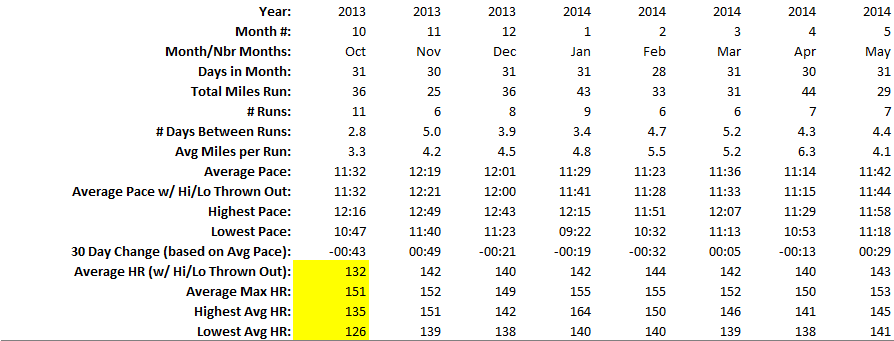

As you can see, my average pace climbed way back up from where it was in April. There’s a pretty simple explanation for that: I had a lousy time running.
If you read Phil Maffetone’s “The Big Book of Endurance Training and Racing“, then you know that proper endurance training is comprised of three different pieces: the structural (training) part, the chemical (eating) part, and the mental part. My biggest problem wasn’t the structural part, although that wasn’t stellar. I only went on seven runs in a 31 day month. My total mileage for the month was all of 26 miles. Structurally, this wasn’t very sound.
Pace was way up whenever I went out for a run. And by up I mean down. Or however you might say it. You know what I mean. The pace that I set in April as an average was lower than the piece that I sent May. I don’t know if that’s supposed to be up or down but you get the drift. A large contributor to this slower pace was the chemical part. I ate like crap last month. I ate whatever I wanted whenever I wanted. Our admin assistant at work has giant bags of candy lying around. Anybody’s welcome to them. Oh, and I did help myself. My weight was up 5 pounds, my sleep was way way off, and I generally felt like crap.
But while chemical was certainly part of the problem, it was what drove the chemical that was the real problem. Maffetone explains that the triangle that makes up endurance training is comprised of these three things equally. And under the mental side of the triangle exists stress. How stressed you are and how well you manage it is a huge contributor to whether your training well. I cannot tell a lie, work has been very stressful recently. Lot of changes, lot of things up in the air, ergo a lot of stress. With the stress, which has led to lousy nights’ sleep, and with the mental side of that triangle being so weak recently, I just haven’t had the interest in running.
I knew I was having trouble with running recently. I mentioned it previously here, as well as what I was most concerned about: loss of conditioning. I think, in reviewing May’s numbers, and in seeing how June has started out, a loss of conditioning has definitely happened. But the truth is, I just haven’t had the drive, the desire to go out and run. The alarm clock goes off and I think “Sleep. Sleep is way better than running right now.” And with that, I slap the snooze button and roll over. What’s interesting is I’m not the only one. I good friend of mine who is also a runner, a really serious runner, said to me just yesterday “I’ve lost interest.” He’s still running, but he’s got to push himself to do it.
So what to do and where to go with this? In my mind, there’s nowhere to go and nothing to do but to keep pushing forward. I view this training program of Phil Maffetone’s as a grand experiment, a chance to see if, by applying his principles, I can make myself go faster and faster still while avoiding injury and keeping my stamina up and my heart rate down. Can I become a competitive runner? So onward I go. The Maffetone Method is not a quick method. It’s not a two month training program that gets you to the result you want. It’s not Couch to 5K app on your iPhone that gets you to run a 5K in eight weeks. It’s a serious training program that can take a few years for the results to be truly remarkable. And you have to apply all the principles, not just the ones you want. So in addition to actually running, I have to eat better and learn how to manage stressful situations better. The eating better has already started, and since the beginning of this past week, I’ve lost the extra five pounds I’d gained, plus one more for good measure. I’m trying to learn to manage the stress side of things, and trying to keep my head in the game, even when I have to talk myself into strapping on the shoes and getting out the door.
So what to do? Keep running.
-
I tend not to write one-off post about running. It’s enough for me to wait until the end of the month and then give a summary of how that month went. But tonight was special. And not special in a terribly good way.
Below I’m going to post some of the images from the running app on my phone. I use Wahoo to track my running. I like the clean interface and the heart rate options that it gives me. I used to use MapMyRun, but it doesn’t let you track your heart rate without a premium subscription. Free versus a paid subscription: free wins almost every time.
So here they are:

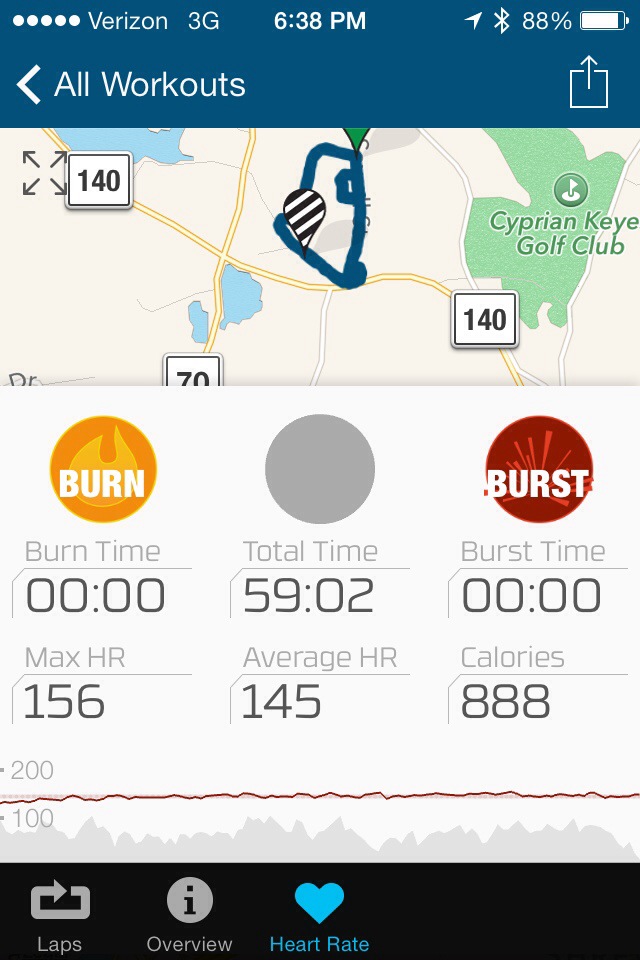

So what, you might ask. What do these images have to do with anything?
Well what is interesting is that my average pace was a lot less than what I have been building it up (down?) to over the last two months. 11:46 is nearly 30 seconds slower than where I had been. Granted it’s only the first week of the month, but still I found this interesting. Why? Hang on, I’ll get there.
In addition to my pace being up, my heart rate was way up. 145 average heart rate, and 156 for the max heart rate.
So, pace down, heart rate up. Why?
If you look at the third image, you will see you that I have only managed to run four times in four weeks. The last run before tonight was only 2 1/2 miles. Per the summary, I ran 8 miles one Sunday, then nothing for a week, then another 8 mile Sunday, then nothing for two weeks, then 2 1/2. (The 2 1/2 was an interrupted run. I would probably have pushed to go farther, but had to call it off. But to be fair, I just wasn’t feeling it.)
I think the bottom line is that I’m losing conditioning. So much time not running (along with eating like crap these days) has meant that the work I’ve been doing on the Maffetone Method is in danger of a big backwards slide. So I think it’s time to knuckle under. But maybe I’m wrong? What say you, out there in Internet-landia?
-
I can’t believe it’s already May. It feels like yesterday that I was bemoaning the fact that running in the cold and the snow sucks. And yet, here we are. May 1st has come around faster than I expected, which leaves my April running behind me.
So how did April go?
I don’t want to complain too much about my April running. The numbers for April were really really good. Like, dropping nearly 20 second off my average pace kind of good. I set off on a mission to focus more on my running schedule since my schedule fell apart in both February and March. Plus, I have my eye on a half marathon on Father’s Day. I’ve now got the schedule set in my head, and I’ve even started blocking off time in my calendar on my phone. But that doesn’t mean it was all peaches and cream.
First, the numbers:


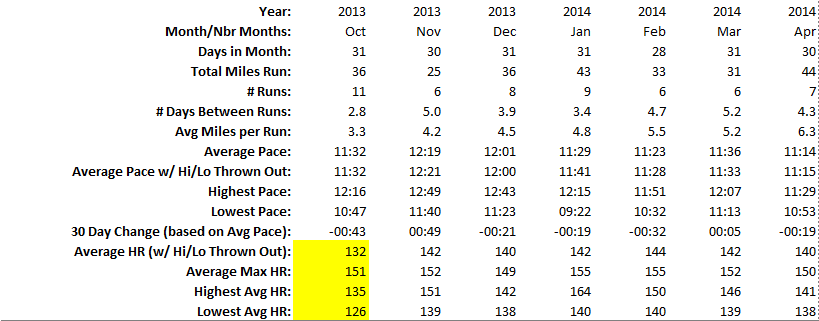
As you can see, my average pace with the high and low thrown on dropped. Like, a lot. 19 seconds, which was far more than I expected. I think this is largely due to two things:
- I got a new heart rate monitor at the end of March. The old one was on it’s last legs and need to be replaced. The new one is great, and I think it is a more accurate measure of how the ol’ ticker is really performing during a run. In addition to the accuracy, I can see on the read-out what the average heart rate is for the total run as I go. It’s a great way for me to gauge whether I need to slow down as the run extends out for several miles.
- The second thing is that Spring is in the air. And while I wouldn’t say it’s warm enough to go swimming just yet, it’s been nice enough that I can get out and run without 50 pounds of winter running gear dragging me down. Not to mention that by the end of March, running in the cold and the dark just plain sucked.
The other interesting trend is that my heart rate is down. My average heart rate, which had been 142, 144, and 142 for the last three months, dropped down to 140 for April. Again, I think this is largely due to a better heart rate monitor. That’s closer to the target heart rate than the previous months, though given the fact that I turned 41 recently, my target heart rate should be 139. Not sure that will happen.
And yet…
I don’t feel I’ve really accomplished a good running post with complaining about something. Maybe I’m just a glass is half empty kind of guy, but I’m trying to be honest in these posts as to how my training is really going. And while I had a great pace improvement in April, it wasn’t all peaches and cream. So what went wrong?
Since April 13th, I’ve run one time. Once. When I get back out there this Sunday, it will have been fourteen days since my last run.
This wasn’t necessarily on purpose, mind you. Sometimes scheduling stuff simply gets in the way. I’ve got a full time job, a family, and other interests (see some of the fiction writing posts and Excel programming posts on this blog and you’ll see what I mean). Sometimes conflicts happen. And with that, the running oft times ends up suffering. But in the end, it’s no one else’s fault but my own. If I really want it to happen, I need to figure it out.
Okay, that’s it. A good month progress-wise. We’ll see in May whether that level of progress was a strange kind of flukey thing, or if that level of improvement continues. In the meantime, back the road. I’ve get 13.1 miles I want to run in June, and I’ve got six weeks to get ready. I need to get serious here…
-
With the end of March, I finished my first six months of using the Maffetone Method as a training program for running. For those of you unfamiliar with the Maffetone Method, you can find more information on Phil Maffetone’s website.
What led me to begin the Maffetone Method? It was two distinct things, really. I talked about both in a previous post, but to recap: I was fighting of a potential foot injury, and I stumbled upon one of Phil Maffetone’s books in the chiropractor’s office.
So began one of the more interesting experiments I’ve done for myself in a long long while.
Like all experiments, I knew I would need data for this one. So I created an Excel workbook. If you haven’t read other parts of this blog, then you don’t know that I’m a pretty sizable Excel geek. I created a workbook and started tracking the data I had available, namely, the date of each run, the number of miles, the pace per mile, the number of calories burned, the average heart rate, and the maximum heart rate.
All of this went into the Excel file, and then I started playing with it, creating statistical formulas with it, and graphing it. The first thing I did was to come up with the average pace per run. Easy enough. It’s just the average pace of all the laps in each individual run. The next thing was to throw out the highest and lowest average pace. My reasoning for this was two-fold: I knew eventually I would start racing (which I did back in January) and so, if I had one race per month (which I knew I wouldn’t, but just in case) then this adjusted average would throw the race pace out. Conversely, anybody can have a crappy training run (I’ve had several, such as this one) and an off day shouldn’t negatively affect your overall numbers. So the high and low pace went. That left the adjusted average pace for the month, and this would become the basis for measuring improvement.
But there’s a whole other piece to the Maffetone Method, and that involves heart rate. In order for the method to work, you’ve got to keep your heart rate at a specific target. Maffetone’s very basic formula is 180 – current age = target heart rate. As you get older, as I am, that drops the target WAY down. Running slow takes some getting used to, although after six months, it’s pretty easy to find a rhythm. But to do this, you need to strap on a heart rate monitor while you run. And this leads to the second major data point I needed to track: heart rate.
Heart rate is a tricky one, I found. I live in the Northeast, where there are hills and hills and more frickin hills. Going up the hill while trying to run at a slow pace means you usually have to drop down to a walk, which I loathe. Even then, the heart rate is going to go up and down. So I’m largely tracking to average heart rate, which is the measure of what your heart did the entire time you were running. Again, I’m throwing out the highest and lowest average for the same reasons I did so with pace: racing and crappy runs.
All this was a nice set up, except for two problems.
The first was a bad heart rate monitor. It was fine for a while, but then it started to do all kinds of weird things, like jump up to 179, then drop to 75, then stabilize around 142. This caused more than a few whiskey tango foxtrot moments for me. In addition to the jumps and drops, it was just not as responsive visually as I needed. Maybe it was recording the data correctly and in real time, but when it would go down as I went up a hill, only to go up at the very end and keep going up as I started down a hill made me realize it was probably shot. (Yes, before you ask, I tried replacing the batteries.) So at the end of March I got a new one (which I like a lot, but that’s for another post).
The second was that I cheated. Not really on purpose, and with the best intentions. I wanted to capture ALL the calories I was burning during a workout, which meant turning on the heart rate monitor even during the warmups and letting it ride during the cool downs. Thus, I was capturing calories burnt better, but I was also influencing the average heart rate by allowing the lower heart rates during warmup and cool down to lower the average. I did this during the first few Maffetone runs in September and all the ones in October, then I stopped. From November on, the heart rate data is cleaner than it was before, which might not be saying much given the quirkiness of the monitor.
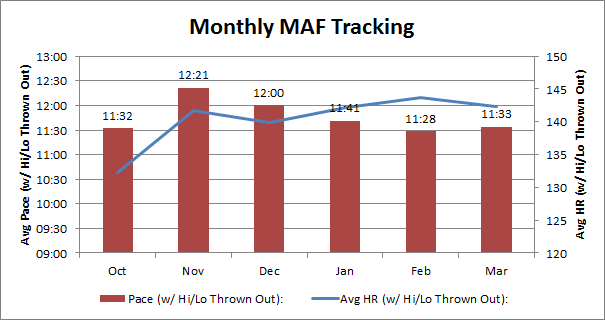
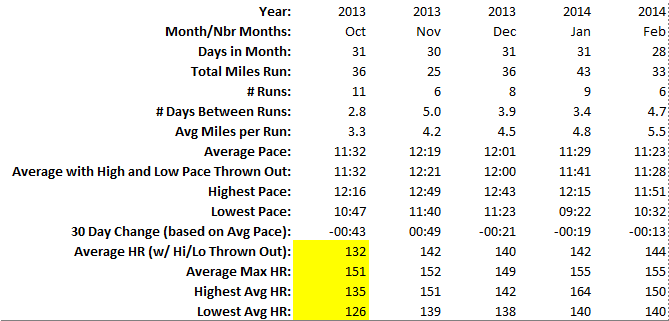
Okay, so that’s enough background. What does the data tell me about the last six months? Well let’s take a look at the artwork (note: this is more or less the same artwork I posted in my update on my sixth month running, but today we’ll be focused on a few different things):
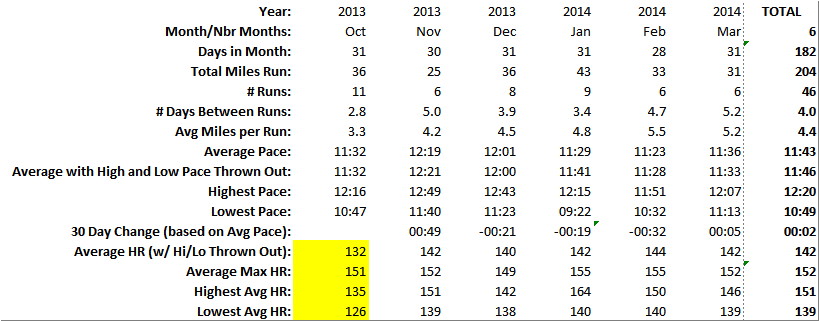

The first thing I looked for was improvement. In its simplest terms, am I running faster now than I was six months ago? At first glance the answer appears to be No, I am not. In fact, I lost a few seconds overall in the adjusted average pace. But that’s compared to October. October seems to be an outlier of sorts. What you don’t see in here are the three runs I did at the end of September when I first started following the Maffetone Method. September’s adjust average pace is a good 45 seconds higher than October. And after October, my pace shot back up into the 12 minute range and has been coming down slowly since. (Not for nothing, but this slow improvement is the kind of improvement I would have expected from the Maffetone Method, and not wild swings.)
What’s the story with October? I can’t speak in absolute certainty, but I’m will to hazard a guess. I think it comes back to the “cheating” I explained above. Knowing that a walking warmup and walking cool down would lower my average heart rate, I think I, consciously or unconsciously, allowed my heart rate run higher during the main body of the run. This would naturally lead to a faster pace, as I could go longer with an elevated heart rate and let the cool down bring the average heart rate down. I say “consciously or unconsciously” because I don’t have a specific recollection of thinking of this strategy through and then executing it, but that was six months ago. So it’s possible. And September? With only three runs in that month and a new method to adjust to, the high pace was largely a matter of “getting used to it”.
In tandem with pace, I looked at my average heart rate. As with pace, this represents a number with the high and low thrown out. What did I see when I reviewed it? I found my heart rate was slowly going up. Not a lot. The highest average heart rate we see above is in February at 144. The lowest, excluding October, is 140. In addition, we seem to have a correlation between the rising heart rate and the falling pace. This one alarmed me. Because if my pace was dropping only because my heart rate was climbing, it means that I’m not really making much progress, only running a little faster without having improved my aerobic capability. Which could lead me to conclude that the method failed.
This is not what I wanted to hear.
It turns out that March, despite what a crappy running month it was (see above that I only got outside six times), my heart rate dropped back down to 142, as it was in January, and my pace between January’s adjusted average and March’s adjusted average dropped 9 seconds, from 11:41 to 11:33. This restored some hope I had that I might actually be improving.
So, assuming I am improving and not just running faster while elevating my heart rate, and if we throw out the skewed data from October, we can see that I improved by 48 seconds, from November’s average pace of 12:21 to March’s pace of 11:33. Over a five month time period, that’s a 9.6 second improvement per month.
But does that mean anything? Let’s put it in some perspective.
If I keep up this slow-run method of training, gaining (for the sake of argument, let’s round down) 9 seconds average per month, then in another two and a half years, the equivalent of thirty more months, I could knock 270 seconds off my average pace. That’s a 4 1/2 minute decrease. That would bring my pace down to 7:03 per mile. With a heart rate remaining in the 142 range. That’s frickin enormous!
Now, let’s add some reality to this. I’m not likely to decrease my pace by 9 seconds every month. There will be off months, there will be setbacks, there will be plateaus. I’m fighting with my foot again, which could be hugely problematic later in those two and a half years. In other words, shit happens. But let’s say that, on average, my pace only decrease by 5 seconds per month. That’s 150 second improvement, or 2 1/2 minutes, which would bring my pace down to 9:03 per mile while keeping my heart rate in that target zone. This is big stuff.
That’s my overall data analysis. But I’m not quite done here yet.
Let me take a step back for a moment from all of this data. I think I’ve sprained my math ligament anyway. I need to hobble to a chair to sit down. What I haven’t done yet is talk in the broad sense of how I feel. I’ll cover that now in two areas: injury and fuel.
The first is injury. How this whole Maffetone Method business got started was that I was developing a pain in my heel and went to the chiropractor to seek help, where I discovered Maffetone’s older book on endurance training. Truth be told though, it wasn’t just my heel, it was also one of my knees getting sore and a tugging going down my hip. The heel was just the biggest problem in the way.
I received treatment in the form of chiropractic care, and my legs and feet started to feel better. I also bought a new pair of shoes that are more minimalist running shoes than I had before. I bought those in early December. Here we are four months later. How do I feel?
The answer is qualified. I feel mostly pretty good. For the first three months or so, my foot felt fine. Only now, within the last few weeks, have I begun to feel the dreaded pain in the bottom of my foot. It could be that I need new shoes again. It’s been four months and about 150 miles on them. It might be time to replace them. I’m not ready to make that call just yet, I’m hoping to get more out of the ones I have, but I might not be able to do it. Especially now that winter appears to be over. With the arrival of Spring and the increase in light, I know I’ll want to go out, if not more often, than at least longer when I do go out.
But the rest of my body feels fine. My legs are good, my knees are not sore, I don’t feel any tugging anywhere. So for the injury side of things, slow running has helped keep me running while keeping me from being injured.
The second item is fuel. What I mean by that is how often I’ve “bonked” when running. When I was running last summer, I would always have at least a gel for a 6 or 7 miler along with a small running bottle filled with vitamin water. For longer runs I’d take a full set of the Clif Blocks.
I’ve run up to eight miles twice since using the Maffetone Method, with the average runs increasing to where I’m doing 5 miles for a regular run.
I have not “bonked” once. Not even shaky. For me, this is one of the most telling things about the Maffetone Method. Since I’m not “bonking”, I don’t appear to be relying on whatever glucose I have in my system. I should therefore be burning fat for fuel. (If only I were eating better, I might be losing the winter weight faster…)
So that’s where I am after six months. I’ll keep posting a month by month review of the immediately preceding month, and at the end of September, expect to see my running year in review.
-
We have arrived at the end of another month. Another month of Maffetone endurance training has passed us by. Well, maybe it’s safer to say that another month has passed us by. Cause the training part was pretty sparse.
The end of March marks the six month of my using the Maffetone method as a training routine to try and improve my endurance and run faster. This doesn’t mean running faster during the training runs, but running faster in races. Since I’ve only done one official race, it will take at least one more for me to get any decent understanding of how this method has been working.
But let’s not get ahead of ourselves! I’ll post a review of the past six months shortly, but for now, let’s focus on March. Which, weather-wise, sucked.
March came in less like a lion and more like a pride of them. It’s going out like a single lion, which I suppose is an improvement. But a lion is still a lion, and when I got in my car this morning, it was sleeting. That changed to snow for a brief period, at which time I thought I might literally have an aneurism. I am so. Sick. Of. Winter. And it showed this March.
I ended February pretty weak, with only two runs in last fourteen days of that month. March started of worse, since I went fifteen days between runs. I ran on March 1st, and then not again until March 16th. I hit the wall. I couldn’t stand the idea of running in the cold and dark any more. I had a hard time even getting out of bed on time. It was the tail end of a long winter, and the tail was barbed.
I finally did get myself up and out, and since that March 16th run, I managed to get myself out the door four more times. A measly six runs in a thirty-one day period. Not too great. Especially for a guy who has delusions of running a half-marathon in June. Yeah. That’s two-and-a-half months away. I might be screwed.
Except…
I caught a little glimmer of hope on my last run. It was on March 28th, after work. Daylight Savings Time is back on, and it’s light now until nearly 7PM. That last run, it was a little rainy, more misty than anything else. But it was 51 degrees. It was the first time I had the chance to run in short and just a few shirts. It was the first time all winter that I could run without having to gear up in fifty pounds of winter protection. It made such a huge difference and was enough to make me remember how much I enjoy running.
(Ask me again how much I enjoy it in the dead of August when it’s 95 degrees.)
So, with all that said, how’d the month stack up statistically? Let’s take a look:

Overall, my average pace with the high and low paces thrown out went up about 5 seconds. Given how little I ran, I think that’s actually pretty good. I also have a new heart rate monitor now that is much more reliable that the one I had been using, so the heart rate data will start to be better to review in the coming months.
Overall, March wasn’t stellar. But April brings new promises, and as the weather gets nicer, I’m hoping my training improves.
That’s it for now. I’ll post a six month review in the next day or two.
-
Okay, I realize the month’s not over yet, as it is still the last day of February. But I can give you my solemn word that I will not be going for a run between now and midnight tonight, so I think the data is safe to review.
So how did February go? I guess if sum it up by calling it a mixed bag.
Let’s start with the graphics:


By the list of stats, you can see that I dropped another thirteen seconds off my pace time. Which is great. That’s the whole idea. Keep running slow and eventually the pace comes down to meet your heart rate without your heart rate having to rise to the occasion. Except my heart rate did rise a little bit, on average. More on that in a minute.
The runs themselves were really good through the first half of the month. I ran my first long run in a while, getting out for a good 8 miles on a Sunday morning. I realize 8 miles is not a long run to a lot of “serious” runners, but for me, it was. I hadn’t run a good long distance run since late last summer, and even when I was getting out more regularly, my longest run ever was 12 miles. Since my goal is to run a half marathon in June, I got start cranking up the mileage to make sure I’ll cross the finish line, rather than be carried over it.
So through the first two weeks of Feb, I was feeling good, running 5 to 6 miles without a care in the world. And then it snowed. And not just snowed, because that’s already happened plenty this winter. No, I mean Snowed with a capital S. In the third week in February we saw four snowstorms over an eight day period. I mean, honest to god, really? That threw a huge monkey in the wrench in terms of aerobic base training. One of Maffetone’s primary recommendations is to train slowly all winter long so that you can race in the spring and summer. Do your aerobic training in winter so your spring/summer racing can serve as your anaerobic training. ‘Cept how do you train during the winter when winter won’t let you?
This is where the treadmill at the local gym should have come in. Shoulda woulda coulda. I should have altered my morning routine to go run on the treadmill to keep the training going. But I hate treadmills. They bore me to tears. Guess I wasn’t all that committed after all.
On top of the Snow with a capital S, it’s been cold. Damn cold. Like, Cormac McCarthy’s The Road kinda cold.
So the last two weeks of February saw just two runs for a total of 8 miles. Pretty anemic. But winter was only half the problem I ran into. (Get it? “Ran” into? Never mind…)
My heart rate monitor has been acting fairly wonky lately. I work in IT and I can tell you that “wonky” is a very technical term. Basically, it would give me strange readings as I ran, usually only for a moment, and return to normal. For example, I looked down at it as I leveled out on one particular street during a morning run. I watched it go from 137 to 213 then back down to 137. Whiskey tango foxtrot. And the monitor doesn’t know enough to think “hmm, that’s strange, maybe that’s a blip we should throw out.” When the run is over and I check the average heart rate and max rate, sure enough, the max reads 213. That does me no good. I have to spend the rest of the run closely monitoring the readings and estimating from what I saw what I think the max heart rate was. God only knows what this is doing to the average. The primary concern I have with this is, how do I know any of the readings have ever been right? I’ve replaced the batteries, but it still happens here and there. I really want to get a new monitor, but the
Magellan Echo is still a little out of my price range.Also on the subject of heart rate, I feel like I’ve lost my feel for pace. The last three runs I’ve run, my average heart rate has been 144. I can usually keep it to 141, 142. My pace for the first two of these runs saw my pace lower that the monthly average by 15 seconds. I thought maybe I was losing conditioning. The last of these three runs I watched my heart rate climb up into that 144 arena. “Here we go again,” I thought. So I (stupidly) cute my run short out of frustration. Three miles and done. I looked at the pace for that run and found I had run it 10 seconds under the average for February. I could have, and would have, sworn I was running a pace like the first two. So I feel I’ve lost my feeling for pace, which is a little bothersome. And to bring in my other issue, how much of this due to a strangely functioning heart rate monitor versus simply losing my feeling for pace. No earthly idea.
So that’s how month five went. I figure winter has to clear out of here at some point. There’s a 10k north of me that happens at the end of April that thinking about. It would be a nice way to get into a racing frame of mind for the June half marathon. But first, I should probably get through March.






 Scott Lyerly