(I originally wrote about this on Substack in June 2025.)
Every so often, I deep-dive in the world of books on writing. I cannot lie, I love a book on craft. It’s fascinating to see how each author approaches the work. From those who espouse beat-by-beat plotting (such as Save the Cat Writes a Novel) to those who go out of their way to exclude plot as one of the core elements of a novel (such Stephen King does in On Writing), every practitioner has a unique approach.
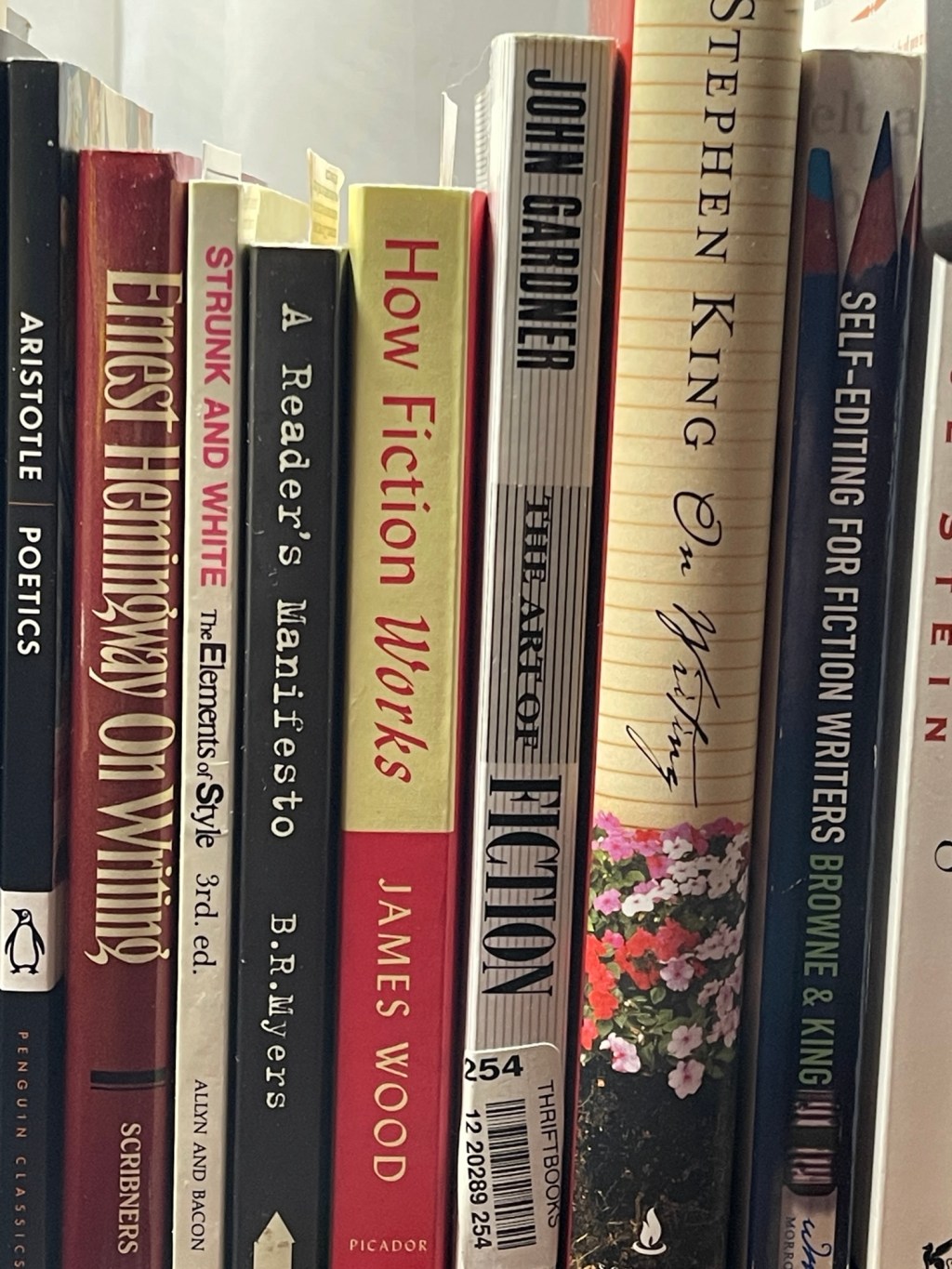
In going back over some old favorites and reading through some new ones, I wanted to give you a list of my top five books on the craft (or craft-adjacent). I love a good book on the craft of writing. Once King released his, On Writing: A Memoir of the Craft, it felt like all the others could be retired. His writing is so conversational it feels like you’re sitting on the porch, rocking in a couple of chairs, jawing about writing.
But, of course, his is not the only book on the craft of writing. So, in the spirit of pulling back the curtain for a peek behind the scenes, here are my five favorites:
- On Writing, by Stephen King – Probably not a surprise given I mentioned it above. It might be the single best-selling book on writing since Strunk and White. And I’d argue Strunk and White only surpasses it because they are required in so many college writing classrooms. King has always had an easy-going style, and his non-fiction is sometimes better than his fiction. It boils down to storytelling, and the first third of his book is him telling the story of his life (to date), which in the original was around the year 2000, and how it made him a writer. It’s marvelous storytelling and a marvelous insight into what made this juggernaut of a pop culture writer so big. The back third of the book is more of the how-to. If you’re looking for the manual of how to write, how to plot and build that three act structure, building character backgrounds, dissect a scene, that kind of deep-in-the-weeds work, then this really isn’t it. This is about the approach, the discipline required, the tools you need to write, and some rules to follow (e.g. cut as many adverbs as possible, etc.). It’s extremely valuable and I’ve read it multiple times.
- The Art of Fiction, by John Gardner – Gardner was a writer of literature and a professor of writing at university. And while I hesitate to call attention to the word “literature”, it cannot be denied that there is a definite hierarchical perception of fiction writing, both from within the writing community and without. I’m not passing judgement, mind you. I know where I fall as a writing of whodunnits and werewolf novels. I only point it out because Gardner might be seen as someone whose advice of writing may not translate well for anyone not engaged in the pursuit of “literature.” And you’d be wrong. While most of Gardner’s examples do come from quote-unquote literature (you’ll never find a reference to V.C. Andrews), the advice and insight into what makes fiction work and how to approach it is exemplary. This is easily one of he best book on writing I have ever read.
- The Elements of Style, by Strunk and White – I’m not sure I even need to explain this one. Unless you’ve been living under a rock for your entire writing career, you’ve heard of this one, probably at least cracked it open to skim it, and might even already own a copy. (If you don’t already own a copy, go buy one. Now.) It contains two parts. The first is by Strunk, designed for his college students as a way to get them to write better papers. It’s all mechanics presented in the straight, no-nonsense manner. The second part is by White (that is, E.B. White of Charlotte’s Web fame). Asked by the publisher to add some notes on style, he did so with a small set of rules that should be taken as gospel. Together, this is an indispensable book, and at bare 100 pages, and slim little volume.
- How Fiction Works, by James Wood – I have never read a book that was not intended as a writing book that taught me so much about writing. Wood takes fiction and completely takes it apart to show how it works. Not at a “and here is the three-act structure, and here is where the denouement happens,” etcetera, but at an even deeper level. For example, when talking about the passage of time in a book, using an example of the main character walking down the street, they may observe various people doing various things (sweeping, cleaning, getting their mail, whatever), which is conveyed through the prose. But each one of these side actions is almost a snapshot and none, obviously, is described simultaneously (it’s a list of actions, after all) and yet we perceive it all as part of a singular moment in time because it’s contained in a single sentence. Even if it happens as the character progresses down the street, we still view it as a whole because of its containment to a single sentence or phrase. Furthermore, what exists outside of the world of these actions? Anything? Can we prove that? After all, the eye, the POV, the “camera” never strays past those actions. Once swept, does the woman go back in the house, and if so where does she put the broom and dustpan? We’ll never know because our involvement in her world stops that moment our character walks past her while she’s sweeping. This is the kind of deep dive Wood offers, and while it’s not a how-to for writers, any writer anywhere would benefit from this dissection.
- The Reader’s Manifesto, by B.R. Myers – This will be the controversial choice, but I find a lot of value in it. This book started out as a self-published volume called The Gorgons in the Pool. Myers sent copies out to major outlets, hoping one might be interested, suspecting none would, when The Atlantic reached out to him. They wanted to publish it but they needed to trim it down. Myers agreed and subsequently lit the hair of the literati on fire. The backlash was strong, even as some critics begrudgingly agreed he had made some good points. The book was reissued by a small publisher, and it’s worth a read. If for no other reason than to keep yourself grounded. Like the ventriloquist you might start writing in another person’s style. But even if that style is immutable, there is always the danger that what you are writing becomes pastiche. Understanding critically where the pitfalls of that style are can help you avoid them. And whether you agree with Myers assessment or not, it never hurts to have an understanding of what the dissenting voices are saying.
These are the five I would suggest. There are plenty of other books on writing, you can pick them up if you really want to, but these are the ones I think give you the best feel for why we do what we do, and what works and what doesn’t. Again, these aren’t going to tell you all of the individual elements that you need to assemble a novel. This just grounds you as to what fictions is, who it works, and how not to make yours suck too badly.
As for reading order, just follow the order I’ve listed them in above. King is a nice, easy-going introduction, Gardner is a more serious study, take a break from the serious study with the read-in-an-hour Strunk and White, which will clear your mind for the deep dive of Wood, after which you can resurface and enjoy some Myers’s Emperor-has-no-clothes assessments of major writing icons.

