
Yet another attempt at a night sky picture using an iPhone. The clouds in front of the moon last night were to cool not to try again.
-
-
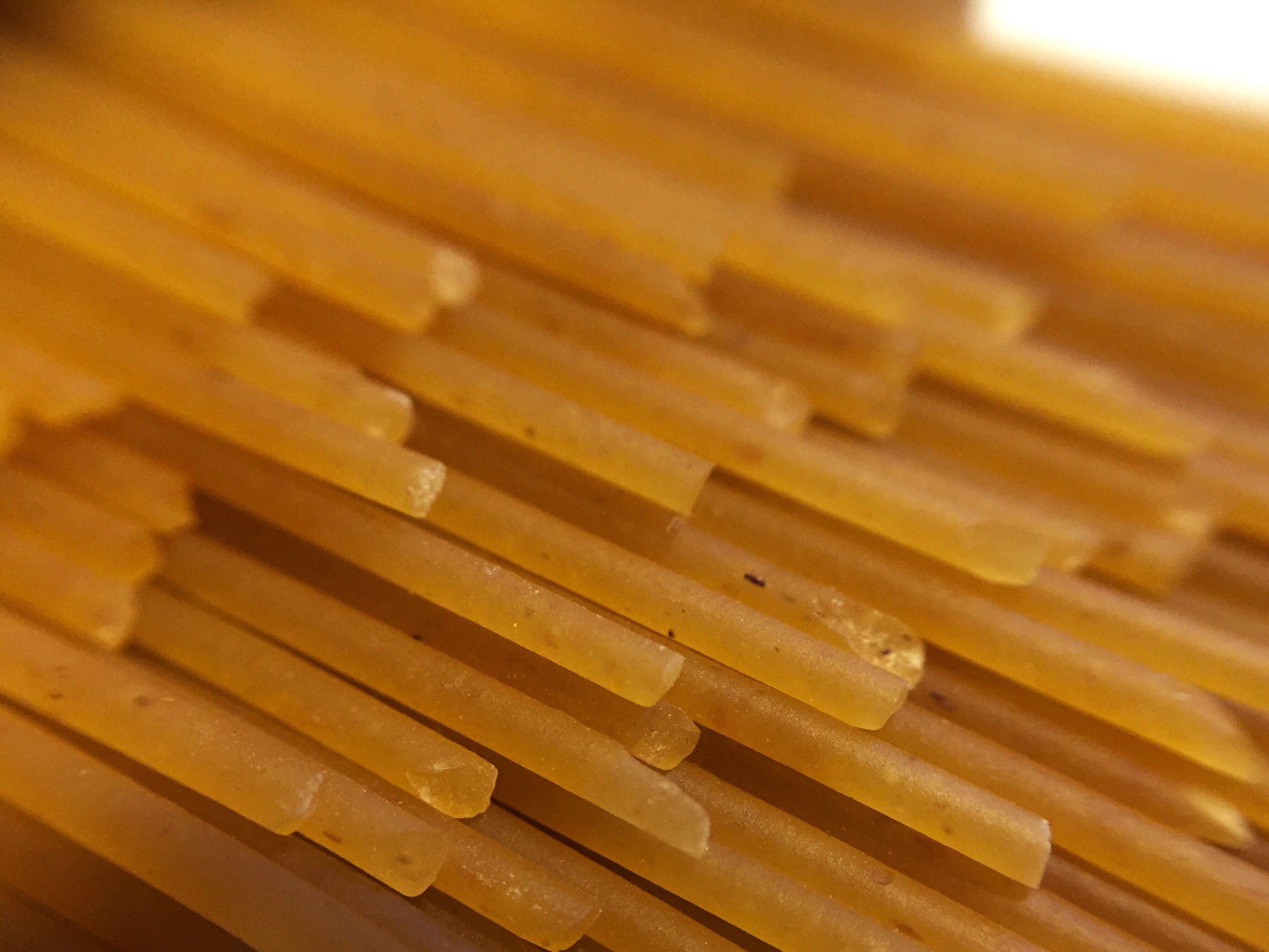
For Macro Monday, may I proudly present…my dinner.This is a view of the pasta just before getting the boiling water treatment.
-
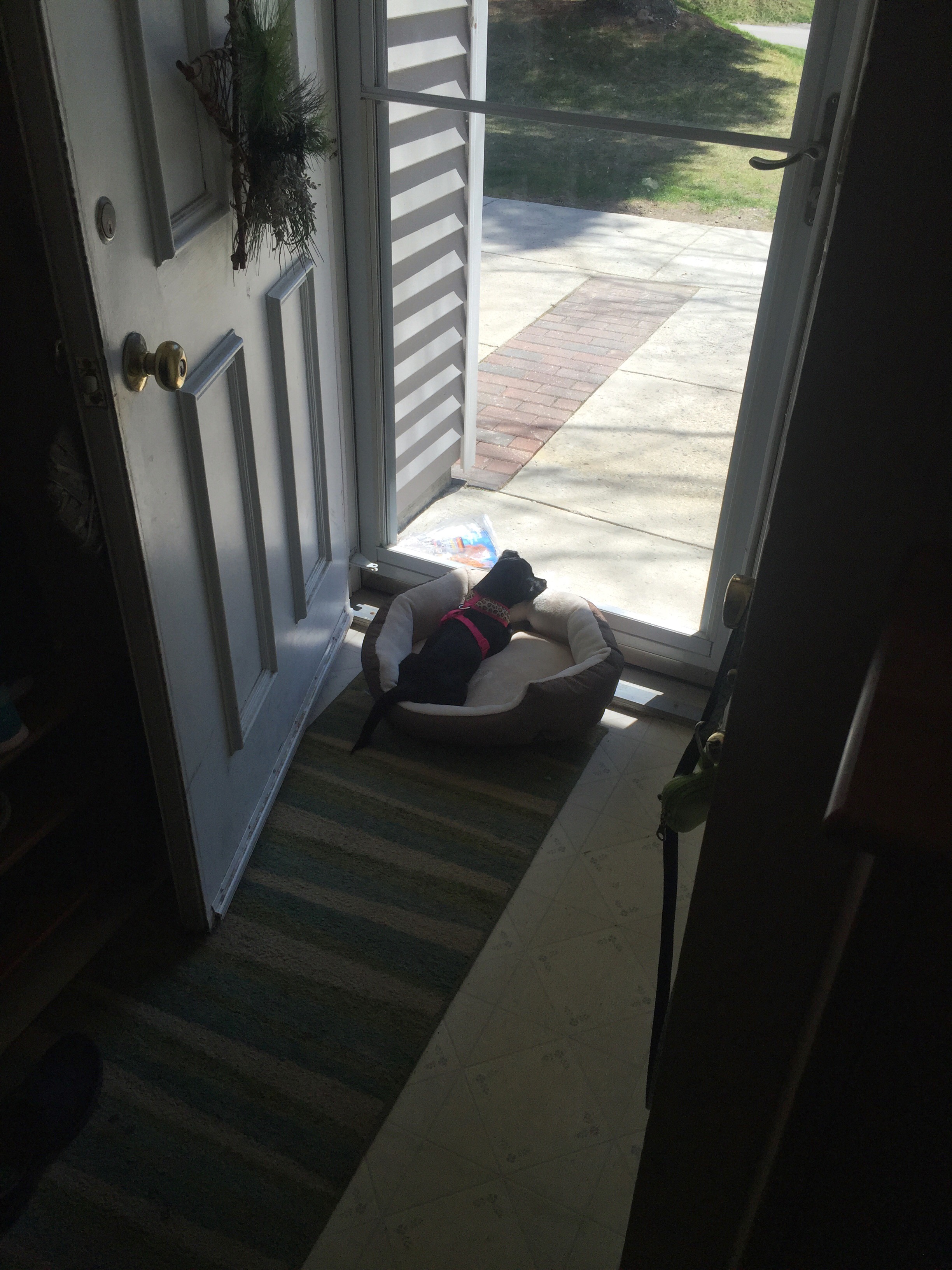
It was a lazy kind of Sunday today, as evidenced by our dog, Harper, just hanging out in her little slice of sunlight. -

The building that houses the ballet school where my younger daughter takes classes is a beat-to-shit old brick warehouse in Worcester. The section that the ballet school occupies is reasonably nice. Jen, the director of the school, has put a lot of work into making the space as comfortable as she can.However, today, a door was open at the back of the school, and I got the chance to glimpse part of the rest of the warehouse. The phrase “urban decay” comes to mind.
I took this photo as I was peeking beyond the school’s door, and tweaked it a little in Snapseed.
-
 “Made To Kill” is a book by Adam Christopher that I really wanted to enjoy. Like, *really* wanted to enjoy.
Alas, I couldn’t even finish it.
There have been a lot of reviews for this book that praise it lavishly for marrying two genres into one good, old-fashioned, B-movie pulp fiction novel. Which is exactly what Christopher is going for in “Made To Kill”. The concept is deceptively simple: What if Raymond Chandler had written science-fiction? It’s an interesting thought, considering how notoriously down on the genre of science fiction Chandler was. In 1953, Chandler sent off a really fantastic letter to his agent regarding science fiction. It’s too fun not to include, so here it is below:
(Source: Selected Letters of Raymond Chandler)
6005 Camino de la Costa
La Jolla, CaliforniaMar 14 1953
Dear Swanie:
Playback is getting a bit tired. I have 36,000 words of doodling and not yet a stiff. That is terrible. I am suffering from a very uncommon disease called (by me) atrophy of the inventive powers. I can write like a streak but I bore myself. That being so, I could hardly fail to bore others worse. I can’t help thinking of that beautiful piece of Sid Perelman’s entitled “I’m Sorry I Made Me Cry.”
Did you ever read what they call Science Fiction? It’s a scream. It is written like this: “I checked out with K19 on Aldabaran III, and stepped out through the crummalite hatch on my 22 Model Sirus Hardtop. I cocked the timejector in secondary and waded through the bright blue manda grass. My breath froze into pink pretzels. I flicked on the heat bars and the Brylls ran swiftly on five legs using their other two to send out crylon vibrations. The pressure was almost unbearable, but I caught the range on my wrist computer through the transparent cysicites. I pressed the trigger. The thin violet glow was icecold against the rust-colored mountains. The Brylls shrank to half an inch long and I worked fast stepping on them with the poltex. But it wasn’t enough. The sudden brightness swung me around and the Fourth Moon had already risen. I had exactly four seconds to hot up the disintegrator and Google had told me it wasn’t enough. He was right.”
They pay brisk money for this crap?
Ray
It’s Chandler’s love affair with detective fiction and his loathing for science fiction that inspired Christopher to combine the two in a single story.
The main character is Ray Electromatic, the world’s last robot. He (it?) just happens to be a private detective in 1960’s Los Angeles. But, due to some basic reprogramming, he now operates more as the world’s last robotic hitman than detective, though being a private detective certainly has it advantages. It lets him move around, ostensibly investigating private cases for clients, but actually killing people for money instead. In this endeavor, he is assisted, if not guided, by Ada, a supercomputer that acts more as an operative handler than a receptionist, though it’s as a receptionist that Ray imagines her in his mind (circuits?). The book opens in a way that has become synonymous with the beginning of a hard-boiled detective novel, a dame walks into the office.
There is so much material in the basic premise that could have been mined for gold. A robot investigating crimes: how does he relate to people who can’t get over the novelty or fear of being questioned by a robot? How does he react when faced with a situation that would willfully go against his base programming? How does he handle himself in a bar fight or a high speed car chase? Or is he perhaps his own vehicle?
Christopher wastes these and other opportunities by making the character a reprogrammed killing machine. Clearly he’s playing against Asimov’s Three Laws of Robotics. Because Ray is a robot, he has no feelings to feel. He’s simply carrying out instructions as fed to him by Ada. Even when stumbling into a weird variation on the commie-Red-Scare motif, around which most of the primary plot takes place, there are no emotional reactions from him. Because our character is nothing more than a thinking piece of metal who kills people for a living, we have no accessible way to empathize with him. He is an anti-hero who is not interesting.
Therein lies another major fault with the book, the distinct lack of character development. Any possibility of making the character of Ray, or his situation, interesting is completely overlooked. A good example is how Ray’s memory works. He runs on a data tape system (this is the ’60s, after all). He has twenty-four hours of data tape, and a battery that lasts on a 24 hour charge. Essentially, if he is not back at his office by midnight, he turns into a pumpkin. This offers so much potential that is missed. The opportunity to turn this into a “Memento” style mystery, where the character must relearn things again each day, could offer such a complex and twisting narrative that you cling on every word, wondering what mystery will be revealed next. Instead, every morning, Ray is filled in on the day before by Ada, then sent on his merry investigative-cum-murderous way. If Ada is filling Ray in at the start of every day, why bother having the prop of a data tape in there at all? Even if Ada feeds Ray bad information for her own purpose, and I suspect maybe she eventually does, it still does not make the characters any more compelling than a hunk of walking metal.
Perhaps the book picks up as it moves along, redeeming itself in the final act. I gave a good 100 pages before I gave up looking for reasons to continue it.
Much of what Christopher is going for is striking a balance between the noir and the fantastical, while keep things from becoming so heavy they sink the book. But in the end, it simply a boring read, with little interesting in the way of character development, to keep you asking “What happens next?” Instead, as we see Ray go and ask another person another question, we ask ourselves, “Who cares?”
The answer is, “Not me.”
-

Fish-Eye Friday. Cause why not? -
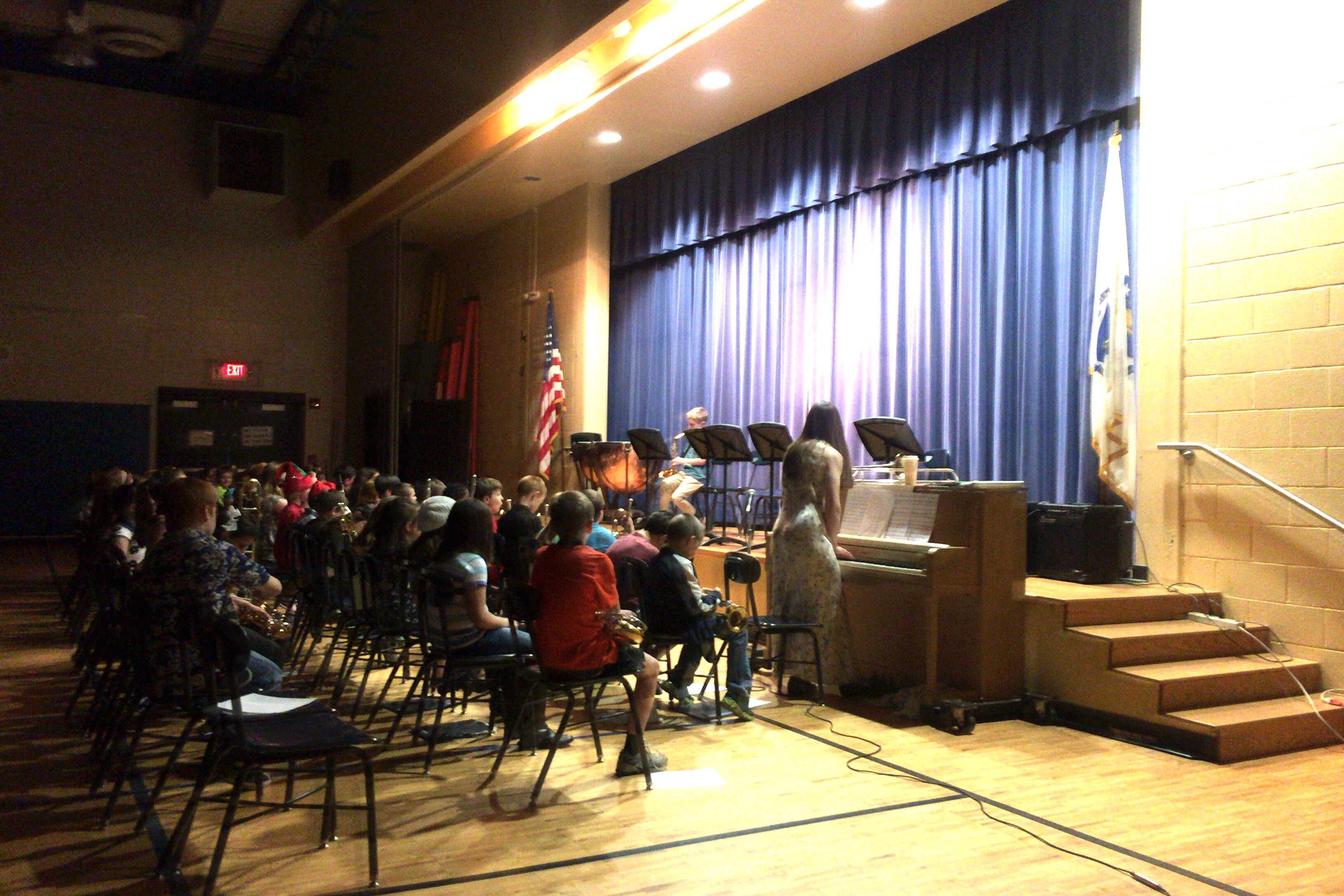
One more picture from the Elementary School band concert last night. -
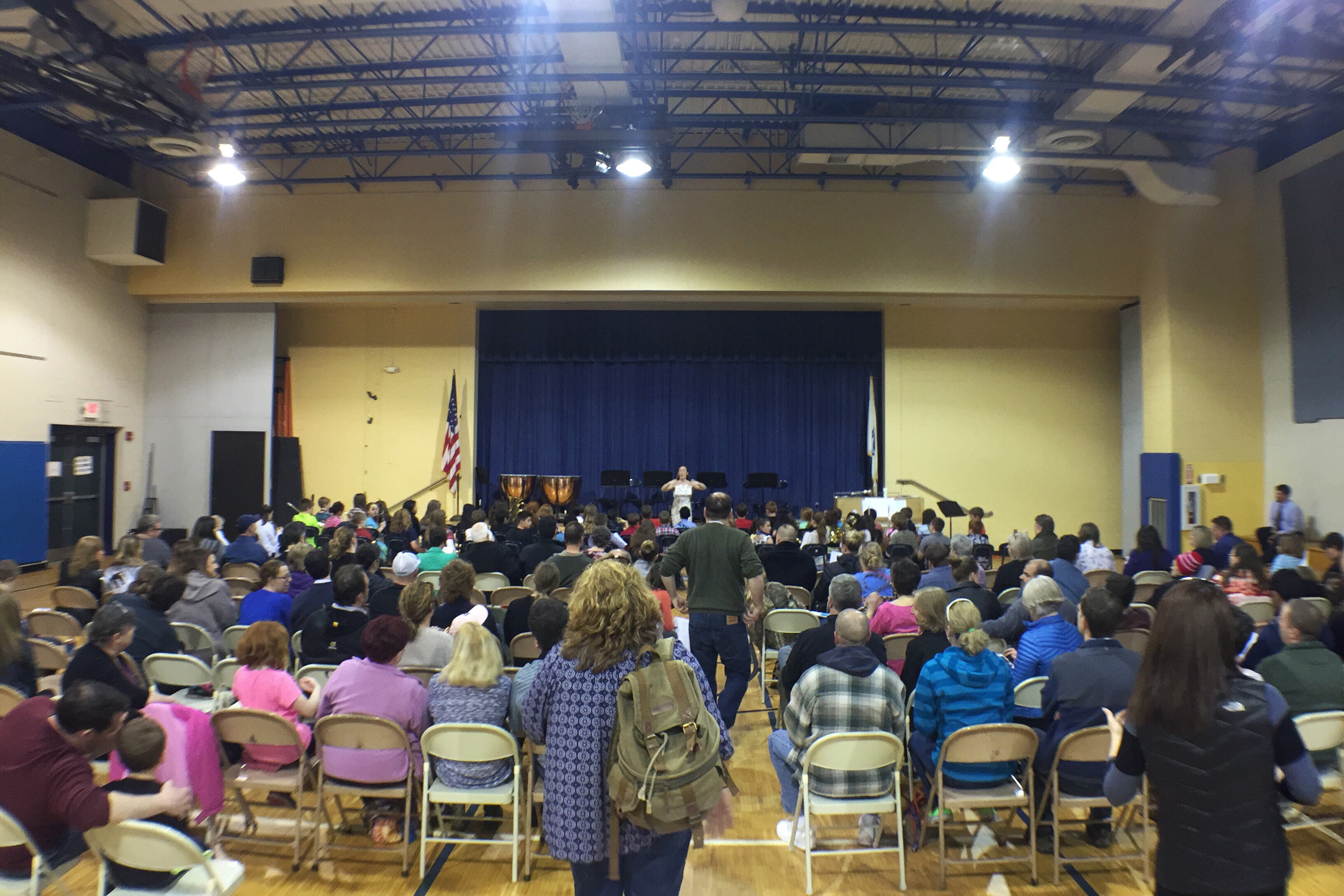
If Mondays are going to be “Macro Monday”, then let’s make Wednesdays “Wide Angle Wednesdays”. This one was taken using the wide angle lens on the Ztylus Revolver iPhone attachment. It was taken at the Elementary School band concert tonight. As you can see, it was a pretty good turn out. Hence the need for a wide angle shot. -

Sometimes you find objects for photos when you’re not even looking for them. Tonight while sitting at the doctor’s office with my younger daughter, we started taking pictures of the objects in the waiting area. Just your average ordinary everyday objects, none of them that interesting.Until the coat rack. It was sitting in a corner all by itself, coatless since the weather is getting warmer. It cast its shadow on the wall, and that’s when I realized it could be interesting.
And interesting it was. When the contrasts were tweaked, the shadow somehow took on a sort of malevolence. Like the coat rack had an evil demon following it.
Sleep tight.
-

I’m stealing a bit from Chuck Wendig when I declare that henceforth, Mondays shall be known as Macro Mondays.Thus, in keeping with our new theme we proudly present for your discerning pleasure, a fork.
 Scott Lyerly