SCOTT LYERLY

  • Home
  • About
    • Contact
    • Bio
    • My Tourette Syndrome Story
  • Books
    • The Last Line
    • Anthologies
  • Other Writing
    • Short Fiction & Essays
    • Blog
  • Upcoming Events
  • Etcetera
    • Newsletter Sign-up
    • Privacy Policy
  • Facebook
  • Instagram
  • Threads
  • TikTok
  • Bluesky
  • My Holiday Movie Pick

    December 10th, 2013

    You may not be interested at all, but I feel compelled to tell you about my pick for the best holiday movie. In these days of ABC Family’s 25 Days Of Christmas, and the never ending cavalcade of movies like Santa Buddies, I feel we have to throw a little darkness into the season.

    (Anybody who knows me is currently saying to themselves, “Scott, you’re going to go toward the dark end of the holidays? Go on!”)

    Yes, it’s true, I have a history of leaning toward things with an edge, the kind of things you read or watch, and like, but don’t tell anybody you like because you don’t want them to think you’re weird or something.

    Except this time, the darkness to which I’m leaning is just a tense, visually compelling, sometimes silly fun movie.

    Queue up the movie, please:

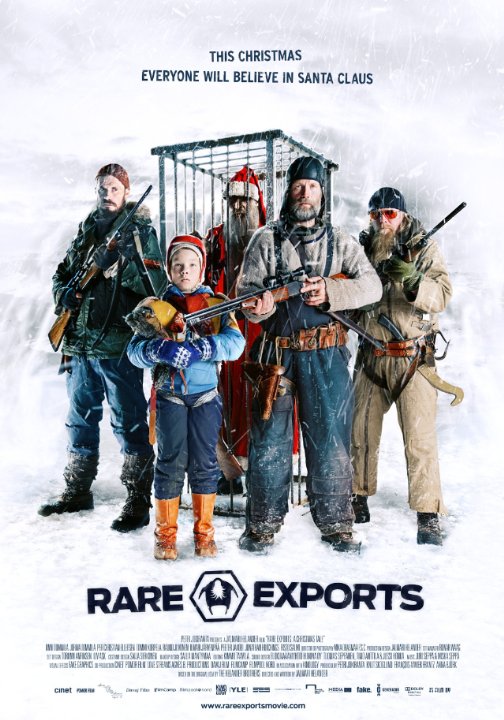
    rareexports

    Rare Exports is a Finnish movie that takes the wholesome image of Santa Claus and makes him perhaps a bit more demon than saint. When a scientist orders the excavation of a nearby mountain, the local reindeer herders find their Christmas harvest disrupted. But when the reindeer end up slaughtered and the local children start disappearing, then a small band of herders and one of their sons realizes perhaps there is something more going on.

    This movie is just plain fun. It’s in Finnish with English subtitles, at least on Netflix. It’s possible, even probable that there is an English dubbed version on the DVD, but since I caught it on Netflix I can’t guarantee it.

    What makes this film work for me is that you never quite know what to expect next. The herders eventually catch a strange and withered being that looks like a naked, wild-eyed Santa Claus after a couple of years on meth. And when you begin to think that maybe you have a handle on who this mysterious mute being is, it turns out you’re horribly horribly wrong.

    There are some moments in the movie that don’t necessarily work as well as the creators intended. When the herders end up at the base camp for the scientific team, trying to make some money by selling off their new-found “animal”, there is a sudden violence that caught me off guard. The heroics at the end are edge over into melodrama and border on downright corny. And the final sequence after the climax of the film stretches the credibly of the entire story.

    But who cares? Some of the visuals in this movie are spectacular, the tension is top notch, and it’s easily the most original take on the Santa myth I’ve seen or read about I years, maybe even ever.

    Do yourself a favor: sit down and watch this one. Only, not with the kids.

  • How Was Your Weekend?

    December 9th, 2013

    My weekend was busy. In fairness, with two kids and the associated kid activities, my weekends are always busy. But when you throw the holidays into the mix, things get downright crazy.

    But, despite having little to no time to sit down and just take a deep breath, the weekend was pretty good. We got the tree up this weekend and started putting up some decorations. My younger daughter was so desperate to get the tree decorated that she started plowing into the box of decorations before I could finish separating them out. And separated they needed to be. One pile for one girl, one pile for the other, then the collective pile that was fair game for both, and lastly, the heavy and fragile stuff that only the mommy and daddy were allowed to touch. That mostly worked…

    Still, no ornaments were hurt in the making of this tree.

    20131209-214856.jpg

    Bonus for me, I got in a really good run on Sunday, which was sorely needed. I was a very grumpy man on Sunday, mainly because there was so much going on and I had control of maybe ten percent of it. When I feel like things are a little out of my reach, i.e. kids yelling at each other, daughter number two digging through fragile ornaments, watching the clock to see if I’d actually have time for a run before starting dinner–it was just a little bit of everything closing in.

    So I put on my (new) running shoes and out the door I went. As I was leaving, the girls decided to put in Shrek The Halls. I think perhaps in was in my honor…

    And then I ran. Five miles, nice easy pace, and just absorbing the stark beauty of the waning day. The storm that was beating the crap out of the mid-Atlantic was headed our way, and the sky was clouding over nicely. I actually stopped and took some pictures of the sky that didn’t turn out sucky.

    20131209-214920.jpg

    20131209-214930.jpg

    So passes another weekend in a blur of motion as we rocket toward Christmas. I’m actually looking forward to Christmas this year, because it means a ten day vacation for me. I’m hoping that will translate to some rest.

    Hope springs eternal.

  • When To Use Quotation Marks In Fiction

    December 8th, 2013

    Of all of the punctuation available to writers in fiction, there’s really only one I’m on the fence about.

    Quotation marks.

    That’s pretty much it.

    I like the period, question mark, comma (in moderation), and a limited use of the exclamation mark. I like the apostrophe, I dig both the possessive and a really good contraction.

    There are a couple I’m ambivalent about, primarily because I almost never find a use for them. These are things like the colon and the semi-colon. They’re nifty looking, and I have absolutely no idea when it’s proper to use them. Perhaps I should qualify that: I have no idea when to use them in fiction. In non-fiction (I do a decent amount of technical writing at work) I use them quite a bit.

    (See what I did there?)

    Some punctuation, like the parenthesis, I love because it totally captures how my mind works. My inner monologue has a lot of asides and side-hand comments and tangents.

    But quotation marks? Well, that’s a tough one.

    When I first started writing fiction, there was the standard use of the quotation mark. Somebody said something, I marked it off by with quotation mark. Pretty standard American stuff. I found that using the apostrophe to indicate dialogue threw me off when I read it. Cannot tell a lie, it’s among the reasons it took me a couple of attempts to get through The Lord of the Rings.

    I never really took to the Irish way of indicating dialogue, with a dash. I’ve never researched it, can’t tell you where that started or why they do it that way, but Irish writers have a tendency to indicate the beginning of dialogue with a dash and then the dialogue happens, and then somewhere it just sort of ends. I’ve never seen it outside an Irish writer, but I’m not terribly well read despite my English lit degree, so maybe it exists elsewhere.

    What does strike me, though, is no use of quotation marks. The first time I encountered it was when I read The English Patient, by Michael Ondaatje. I found it incredibly hard to follow and I feel it made my enjoyment of the book suffer. (I didn’t enjoy the book anyway, but that’s a different issue.) Then next time I encountered this was in The Road, by Cormac McCarthy. Holy mother of god, what a book. The lack of quotation marks made such an impression on me, the way the stark visual of the page reflected the stark bleakness of the story. I was hooked.

    Which then brings me to my conundrum: to use quotation marks or not to use quotation marks?

    When I wrote How It Ends, I wrote in a standard way, using quotes and commas and periods and the like. I read The Road while editing How It Ends and it changed the way I approached my fiction. That’s a whole separate topic, but I don’t want to digress too much. While editing, I ended up stripping out a huge amount of punctuation. This led me to rewrite portions of the book in a different way, since the punctuation that might normally have guided a reader through the book was suddenly gone. It’s like hiking on a trail through the woods and having the blazes removed. You better make sure that trail is in good order and easy to find and follow, or you’ll be sending out rescue crews to find lost hikers.

    Eventually I put the punctuation back, but the removal of the punctuation altered the course and flow of the book, hopefully (and I feel) for the better.

    So do I like the use of quotation marks in fiction? Or do I dislike them?

    For me, the answer is: both. If the story is the right kind of story in which to have the quotation marks removed, then by all means, get ’em outa there. I have a story like that that I may one day polish and publish. (Maybe. It’s a really dark one.) But unless the story is the right kind of story, and the prose you write is strong enough to stand up without crutches, then I think you’re safest using quotation marks to indicate your dialogue.

  • The Maffetone Method – 2 Months In

    December 6th, 2013

    I’m a little late with this one, and I’m sure everyone’s been waiting with bated breath to see how my second month of using the Maffetone Method for running has gone. So without further ado, I present…month 2.

    Okay, kidding aside, I can sum up month two in a single word: frustration.

    I’ve been tracking all of my runs, and the various bits and pieces of data associated with each. This includes things like pace, heart rates, mileage, etc. And what I have found is that the pace, while it improved dramatically in one month from where I started (back in September), it has declined almost as dramatically in the second month.

    What to make of that? A couple things, actually.

    The first, and probably biggest one, is that I shouldn’t get caught up in the data. This probably sounds counterintuitive given the fact that I’m collecting all this data just to analyze my performance. But one of the biggest dangers is that, by tracking this over every single run, I’ll get caught up in it and forget to step back and see the big picture. Maffetone actually warns of this in his book. It’s the same as a person trying to lose weight and getting on the scale every day and being disheartened at the up and down fluctuations. Yes, day over day, your weight might yo-yo, but don’t forget that over a six month period (for example), you’ve lost twenty pounds.

    The second this is the number of runs. In October I found time to run eleven times, for a total of 36 miles. In a month of 31 days, that’s one run every 2.8 days. In November, I only ran six times, totaling 25 miles, and averaging one run every 5 days. My focus hasn’t been as sharp for running in November, and it’s been cold and dark in the morning and the evening, and let’s be honest—running in the cold and dark sucks. But with only half the number of runs in the same (roughly) 30 day time frame, why would I even begin to expect improvement?

    Third thing is shoes. My old shoes were, well, old. And my feet have been hurting. Read about that here. It’s been much harder to get out and run and actually enjoy it when you know that an hour after running you’ll be limping. So I have a new pair of shoes. I’m giving them a good solid test this month and hopefully that will get me out and moving again more often.

    The last thing I guess I’d pull out from all this is that I actually don’t know if this method and my progress using this method has helped. And I won’t know until I race. I’ve never raced before, I’ve just wanted to get out and run. But as I grew stronger this summer, I felt that maybe I did want to start racing. At the very least, I wanted to see how fast I could get. Problem with following a method for training is that I have exactly zero baseline on which to base my progress. What I can say is that, before switching over to the Maffetone Method, I could run six miles at an 8:40 pace. When I finally jump into a race, I’ll be able to tell whether that 8:40 pace is lower or higher. Then I think I’ll have a better understanding for how I’m progressing.

    So that’s the summation of month two. Below you’ll find some stats and my running chart for September, October, and November. You know, in case you truly that interested.

    running month 2

    maffetone_pace_month2

  • Places To Send Your Sci-Fi Novel

    December 5th, 2013

    penguin daw

    Did you know that you can actually get into a relationship with one of the big publishers, Penguin, without an agent?

    It’s true. I swear.

    Know how? DAW. That’s how.

    What’s DAW? They’re a book publisher. Started back in the 70s by Donald A. Wollheim (get it? D.A.W.? DAW?) and his wife Elsie, they were devoted exclusively to science fiction and fantasy. And they’ve published some serious science fiction talent. Names like Tad Williams, C. J. Cherryh, and Mercedes Lackey.

    They’re still a private company. They’re headquartered at Penguin, and have a distribution partnership with Penguin, but still private. I’m not sure how that all works, but I don’t have to. And neither do you!

    DAW has been accepting unagented submissions for years. I first stumbled on this over a decade ago. At the time, I didn’t have anything to submit to them. But I tucked away the knowledge that they didn’t require an agent for when I did have something ready.

    So if you have somthing ready to go and you’re banging your head against the wall looking for an agent, why not go right to the source?

  • Excel Geeking: Using VBA With Configuration Files

    December 3rd, 2013

    Nothing like a good old fashioned configuration file to make you feel like you’re programming in 1995. But you know what? Sometimes you just need to do it. And it still amazes me how many off-the-shelf applications still rely on INI files to store their settings (I’m looking at you, LotusNotes!).

    Personally, I like INI files. I find them easy to work with and easy to deploy. And, of course, it doesn’t hurt that you can read and write to them using VBA.

    If you Google reading or writing to INI files using VBA, you’ll get a bunch of different results, all pointing you in the same basic direction. Specifically, you need to use two different Windows APIs in order to do this “GetPrivateProfileString”, and “WritePrivateProfileString”. One reads from an INI file, the other writes to it. I’m going to assume you can figure out which is which.

    Invariably, the examples you uncover on Google show that these routines are always separate. One routine fo reading, one for writing.

    I hate that.

    I like my code as concise as possible while still being as modular as possible. What do I mean by that? I mean that I want a routine (or function in this case) that I can call from another point in the code and choose whether I’m reading or writing to the configuration file. And I want the routine portable enough so I can drop it into any application I want and not have to worry about customizing it too terribly much.

    And so, I give you the code below, commented for your pleasure:

    
    '*******************************************************************************
    ' Declaration for Reading and Wrting to an INI file.
    '*******************************************************************************
    
    '++++++++++++++++++++++++++++++++++++++++++++++++++++
    ' API Functions for Reading and Writing to INI File
    '++++++++++++++++++++++++++++++++++++++++++++++++++++
    
    ' Declare for reading INI files.
    Private Declare Function GetPrivateProfileString Lib "kernel32" _
        Alias "GetPrivateProfileStringA" (ByVal lpApplicationName As String, _
                                          ByVal lpKeyName As Any, _
                                          ByVal lpDefault As String, _
                                          ByVal lpReturnedString As String, _
                                          ByVal nSize As Long, _
                                          ByVal lpFileName As String)As Long
                                          
    ' Declare for writing INI files.
    Private Declare Function WritePrivateProfileString Lib "kernel32" _
        Alias "WritePrivateProfileStringA" (ByVal lpApplicationName As String, _
                                            ByVal lpKeyName As Any, _
                                            ByVal lpString As Any, _
                                            ByVal lpFileName As String)As Long
    
    
    '++++++++++++++++++++++++++++++++++++++++++++++++++++
    ' Enumeration for sManageSectionEntry funtion
    '++++++++++++++++++++++++++++++++++++++++++++++++++++
    
    Enum iniAction
        iniRead = 1
        iniWrite = 2
    End Enum
    '*******************************************************************************
    ' End INI file declaratin Section.
    '*******************************************************************************
    
    Function sManageSectionEntry(inAction As iniAction, _
                                 sSection As String, _
                                 sKey As String, _
                                 sIniFile As String, _
                                 Optional sValue As String)As String
    '*******************************************************************************
    ' Description:  This reads an INI file section/key combination and
    '               returns the read value as a string.
    '
    ' Author:       Scott Lyerly
    ' Contact:      scott.c.lyerly@gmail.com
    '
    ' Notes:        Requires "Private Declare Function GetPrivateProfileString" and
    '               "WritePrivateProfileString" to be added in the declarations
    '               at the top of the module.
    '
    ' Name:                 Date:           Init:   Modification:
    ' sManageSectionEntry   26-Nov-2013     SCL     Original development
    '
    ' Arguments:    inAction    The action to take in teh funciton, reading or writing to
    '                           to the INI file. Uses the enumeration iniAction in the
    '                           declarations section.
    '               sSection    The seciton of the INI file to search
    '               sKey        The key of the INI from which to retrieve a value
    '               sIniFile    The name and directory location of the INI file
    '               sValue      The value to be written to the INI file (if writing - optional)
    '
    ' Returns:      string      The return string is one of three things:
    '                           1) The value being sought from the INI file.
    '                           2) The value being written to the INI file (should match
    '                              the sValue parameter).
    '                           3) The word "Error". This can be changed to whatever makes
    '                              the most sense to the programmer using it.
    '*******************************************************************************
    
    On Error GoTo Err_ManageSectionEntry
    
        ' Variable declarations.
        Dim sRetBuf         As String
    Dim iLenBuf         As Integer
    Dim sFileName       As String
    Dim sReturnValue    As String
    Dim lRetVal         As Long
        
        ' Based on the inAction parameter, take action.
        If inAction = iniRead Then  ' If reading from the INI file.
    
            ' Set the return buffer to by 256 spaces. This should be enough to
            ' hold the value being returned from the INI file, but if not,
            ' increase the value.
            sRetBuf = Space(256)
    
            ' Get the size of the return buffer.
            iLenBuf = Len(sRetBuf)
    
            ' Read the INI Section/Key value into the return variable.
            sReturnValue = GetPrivateProfileString(sSection, _
                                                   sKey, _
                                                   "", _
                                                   sRetBuf, _
                                                   iLenBuf, _
                                                   sIniFile)
    
            ' Trim the excess garbage that comes through with the variable.
            sReturnValue = Trim(Left(sRetBuf, sReturnValue))
    
            ' If we get a value returned, pass it back as the argument.
            ' Else pass "False".
            If Len(sReturnValue) > 0 Then
                sManageSectionEntry = sReturnValue
            Else
                sManageSectionEntry = "Error"
            End If
    ElseIf inAction = iniWrite Then ' If writing to the INI file.
    
            ' Check to see if a value was passed in the sValue parameter.
            If Len(sValue) = 0 Then
                sManageSectionEntry = "Error"
    
            Else
                
                ' Write to the INI file and capture the value returned
                ' in the API function.
                lRetVal = WritePrivateProfileString(sSection, _
                                                   sKey, _
                                                   sValue, _
                                                   sIniFile)
    
                ' Check to see if we had an error wrting to the INI file.
                If lRetVal = 0 Then sManageSectionEntry = "Error"
    
            End If
    End If
        
    Exit_Clean:
        Exit Function
        
    Err_ManageSectionEntry:
        MsgBox Err.Number & ": " & Err.Description
        Resume Exit_Clean
    
    End Function
    

    Some thoughts on what’s going on here:

    I’ve taken the two APIs that you would call to read and write to a configuration file and put them into a single function. I’m choosing which action to take based on the inbound inAction parameter.

    That parameter, inAction, you may have noticed is an enumeration set up at the top of this module. I like the enumeration in this case because it lets me be very specific in my choice of action to take with regard to the INI file. Yes, I could have saved four lines of code by using a boolean instead. I could have set the function to “read” if TRUE and “write” if FALSE. Except I hate that option. I like enumerations for explicitly spelling out what my options are for value for a specific parameter. That way there’s no confusion.

    So what does the implementation of this function look like? Glad you asked! I’ve included a sample routine below that you easily use to test this function out.

    
    Sub SampleINIFunctionImplementaion()
    
        Const sINI_FILE As String = "C:\Users\scott\Desktop\fruits & veggies.ini"
    
        Dim sReturn As String
    
        ' Read the ini file
        sReturn = sManageSectionEntry(iniRead, "Produce", "Fruit", sINI_FILE)
        MsgBox sReturn
        sReturn = sManageSectionEntry(iniRead, "Produce", "Vegetable", sINI_FILE)
        MsgBox sReturn
    
        ' Write to the ini file
        sReturn = sManageSectionEntry(iniWrite, "Produce", "Fruit", sINI_FILE, "banana")
        sReturn = sManageSectionEntry(iniWrite, "Produce", "Vegetable", sINI_FILE, "squash")
    
     End Sub
    

    That’s about it. Feel free to copy and paste and use for your own Excel applications.

    (Fine print: use at your own risk, blah blah blah…)

  • Blame Hugh Howey

    December 2nd, 2013

    I’ve got two parts of my novel How It Ends up and published on Amazon, here and here. Part three will be coming out in the early part of January.

    You might be wondering why I’m serializing it rather than just releasing it in a single volume.

    Well, even if you’re not wondering, I’m gonna tell you why. (This is your opportunity to click out of this page.)

    The reason is Hugh Howey. It’s his fault.

    If you’re a writer, and you’re self-publishing your material, and you haven’t heard of Hugh Howey, then you’ve been living (and writing) under a rock.

    Hugh Howey is the author of Wool, a science fiction, post-apocalyptic dystopia, that was has taken the publishing world by storm. If you want the full history of Wool, you can check out the Wall Street Journal article on it. The short version is that Mr. Howey published the first part of Wool as a short story in Amazon for $0.99. In the few months, it had sold 1,000 copies and readers were asking for a sequel.

    He’s now making seven figures and has a movie deal.

    Okay, so, I have no expectations about making seven figures. It took me a decade, but I finally broke out of the idea that I would write for money. If you’re writing for money rather than to tell a good story, you’re writing for the wrong reason.

    However, Hugh Howey’s story represents the holy grail of self-publishing. The idea that a lone writer, crafting fiction and self-publishing it, without agents, houses, or editors, suddenly having such huge success–well, that’s a pretty enticing dream.

    And it might just be a dream. Then again, it might not.

    So I’ve decided to take a page out of the Hugh Howey handbook. I’m serializing my novel in four parts, keeping the price point down for each piece, with a final omnibus version to be published when the whole thing is complete.

    How’s it going so far?

    I’m up to 5 copies sold. 995 copies to go.

  • My Foot Hurts

    November 30th, 2013

    And I’m very unhappy about.

    I went out for a run on Friday, trying to run off the seventy pounds of turkey, stuffing, potatoes, etc. that I mainlined on Thanksgiving. It was a good run, six miles, which ended up being one mile more than I had initially planned. Once I was out there, I realized I would let the road just sort of lead me, which is exactly what it did.

    First time I’d run six miles on a few months. Around the beginning of September my knee started to bother me, and then my heel, then my whole foot. I did some reading and was starting to panic that I was developing the dreaded plantar facisitis. Which is exactly the time I discovered the Maffetone Method.

    I’ve been trying the Maffetone Method for about two and a half months. I’ve got another update coming in a few days about how it went in month two. But for now, I’ll simply say that I went for a nice slow aerobic base building run.

    Until yesterday all of my runs have been three miles, with a few at five. This was the first time I’d run six. And when I came back in, I felt great. Legs were good, I felt like I could’ve run another six.

    An hour later, my foot hurt so badly I was limping.

    Dammit.

    I’ve been reading Born To Run. Riveting. I’m completely digging this book. And it makes a good case for barefoot running. Now, I’m not crazy enough to go completely barefoot. Not yet, anyway. Especially not heading into a New England winter. Aside from potential stress fractures, I’m not big into frostbite. So I’ve decided I’ve got to try a minimalist shoe. Because my foot shouldn’t hurt like this.

    So I’ve ordered this little beauty.

    20131130-083438.jpg

    This shoe should be in by Wednesday, which means trying it out in the cold dark of Thursday morning.

  • Shout Out to Contextures

    November 27th, 2013

    I have to give a quick shout out to Contextures. This is an Excel blog run by Debra Dalgleish. She’s an a Excel MVP (read more about MVPs here) and her site is one of three sites I regularly frequent if I’m looking for Excel info. (The other two are Chip Pearson’s Excel site and Dick Kusleika’s Daily Dose of Excel.)

    On Monday I started to see the traffic on my blog really jump up. One of the things I like about WordPress is their site stats, which, in part, show you what the referring site was to your site. (I’m sure other blogging sites do this too, but honestly I’m too lazy to check.)

    Checking the referring sites showed me that the site sending me the most tragic was Debra’s blog at Contextures. Seems she liked my post on creating a back door into your workbooks enough to add it to her weekly roundup post. Suddenly I have more than two readers!

    So here’s a shout out to Debra! Thanks for the props!

  • Formatting Dialogue

    November 26th, 2013

    One of the blogs I follow is Read To Write Stories, by Michael Noll. It’s a blog dedicated to delivering ideas about how to write, and offering writing prompts and exercises to get the creative juices flowing.

    Today’s post was all about dialogue, and how to make dialogue in your fiction move faster. As an example, he offers a story called Paper Tiger, by Liz Warren-Pederson. The way Warren-Pederson structures her dialogue is by having large blocks of it in a single paragraph. Take the following opening paragraph as an example:

    “I want to invite the kids for Thanksgiving this year,” Cynthia said, and I said, “What the fuck? Where will I eat,” and she said, “I was hoping you’d eat with me, next to me,” and I said, “What a fucking misery,” and she said, “That’s not what you said last night,” and I said, “Well, we weren’t under a microscope then,” and she said, “You worry too much,” which was so off-base that I didn’t bother to respond.

    Given how the author has set up the voice of the narrator, this works pretty well. And yes, it moves along at a zippy pace.

    But does it move too fast?

    Micheal Noll’s post it made me think about was the structure of dialogue in my own writing, and that of other writers whose narrator’s are telling the story. The book I’m currently writing is a first person narrative in the hard-boiled crime fiction genre. Given how fond I’m an of Robert B Parker’s Spencer series, my choice of subject matter is probably not surprising. Yet even as a write my novel, I’m trying to avoid a certain pitfall Parker often fell into. Take the following excerpt from Hugger Mugger:

    Good morning,” I said, to let them know there were no hard feelings about them interrupting me.

    “Spenser?” the man said.

    “That’s me,” I said.

    “I’m Walter Clive,” he said. “This is my daughter Penny.”

    “Sit down,” I said. “I have coffee made.”

    “That would be nice.”

    I went to the Mr. Coffee on the filing cabinet and poured us some coffee, took milk and sugar instructions, and passed the coffee around.

    When we were settled in with our coffee, Clive said, “Do you follow horse racing, sir?”

    “No.”

    “Have you ever heard of a horse named Hugger Mugger?”

    “No.”

    “He’s still a baby,” Clive said, “but there are people who will tell you that he’s going to be the next Secretariat.”

    “I’ve heard of Secretariat,” I said.

    “Good.”

    “I was at Claiborne Farms once and actually met Secretariat,” I said. “He gave a large lap.”

    In fourteen lines of dialogue, there are nine what I would call “he saids”, where the author inserts a “he said” or “she said” or “I said” to anchor you to who is speaking. This is a lot. It didn’t occur to me just how many this really was until I was talking to my mother about Spenser books. She likes to listen to the audio version, but she couldn’t do it with Spenser books because of all the “he saids”. Whereas, as a reader, I think we have a tendency to pass right over then, registering them in the barest way possible so that they don’t slow down the dialogue.

    Now compare this to a book I just finished rereading this morning, The Sun Also Rises, by Ernest Hemingway:

    “Couldn’t we live together, Brett? Couldn’t we just live together?”

    “I don’t think so. I’d just tromper you with everybody. You couldn’t stand it.”

    “I stand it now.”

    “That would be different. It’s my fault, Jake. It’s the way I’m made.”

    “Couldn’t we go off in the country for a while?”

    “It wouldn’t be any good. I’ll go if you like. But I couldn’t live quietly in the country. Not with my own true.”

    “I know.”

    “Isn’t it rotten?” There isn’t any use my telling you I love you.”

    “You know I love you.”

    “Let’s not talk. Talking’s all bilge. I’m going away from you and then Michael’s coming back.”

    “Why are you going away?”

    “Better for you. Better for me.”

    “When are you going?”

    “Soon as I can.”

    “Where?”

    “San Sebastian.”

    “Can’t we go together?”

    “No. That would be a hell of an idea after we’d just talked it out.”

    “We never agreed.”

    “Oh, you know as well as I do. Don’t be obstinate, darling.”

    “Oh, sure,’ I said. ‘I know you’re right. I’m just low, and when I’m low I talk like a fool.”

    I sat up, leaned over, found my shoes beside the bed and put them on. I stood up.

    “Don’t look like that darling?”

    “How do you want me to look?”

    “How do you want me to look?”

    “Oh, don’t be a fool. I’m going away to-morrow.”

    “To-morrow?”

    “Yes. Didn’t I say so? I am.”

    “Let’s have a drink, then. The count will be back.”

    Did you count them? That’s twenty-eight lines of dialogue, and only one “he said”. And while the structure is completely different then Warren-Pederson’s story, I find this dialogue moves just as quickly.

    So which is the right one? I suppose that depends on personal preference. My gut tells me that Warren-Pederson’s structure would be simply exhausting for anything longer than a short story. Reading a novel in that format would leave me panting. Plus, in a structure such as this, the writer must absolutely include on a 1:1 ration a “he said” for each line of dialogue. One the other hand, Hemingway’s structure left me panting as mush as “Paper Tiger”, where I found myself grateful for the blocks of descriptive text at the end of each dialogue jag so that I could catch my breath. And Parker’s copious inclusion of all the “he saids” borders on distracting the reader and throwing them out of the story.

    I feel that, for my own writing, there is a happy medium to be found in the number of “he saids” included in the story. Somewhere between one and nine…

←Previous Page
1 … 35 36 37 38 39 … 41
Next Page→

Create a website or blog at WordPress.com


Loading Comments...
 

    • Subscribe Subscribed
      • Scott Lyerly
      • Join 200 other subscribers
      • Already have a WordPress.com account? Log in now.
      • Scott Lyerly
      • Subscribe Subscribed
      • Sign up
      • Log in
      • Report this content
      • View site in Reader
      • Manage subscriptions
      • Collapse this bar